Alcon IOL Lens Price in India 2026 : Types, Cost Breakdown


Copy Link

 Medically Reviewed by Dr. Jaideep Dhama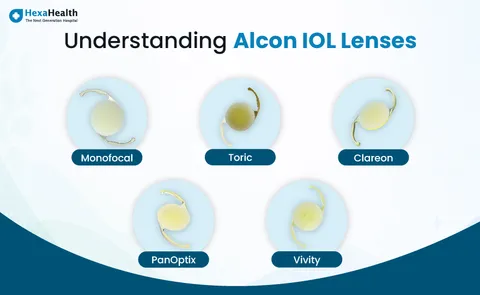
Quick Summary
- Alcon offers three main types of IOLs: Monofocal (AcrySof IQ), Monofocal Toric (AcrySof IQ Toric), and Multifocal (AcrySof IQ ReSTOR).
- The approximate package cost for Monofocal IOLs ranges from ₹30,000–₹50,000 per eye.
- Monofocal Toric IOLs have a package cost between ₹45,000–₹60,000 per eye.
- Multifocal IOLs are the most expensive, with costs approximately between ₹50,000–₹70,000 per eye.
Table of Contents
- What is an Alcon IOL Lens?
- Why Choose Alcon?
- Alcon IOL Lens Price List in India: Detailed Breakdown (FY 2026)
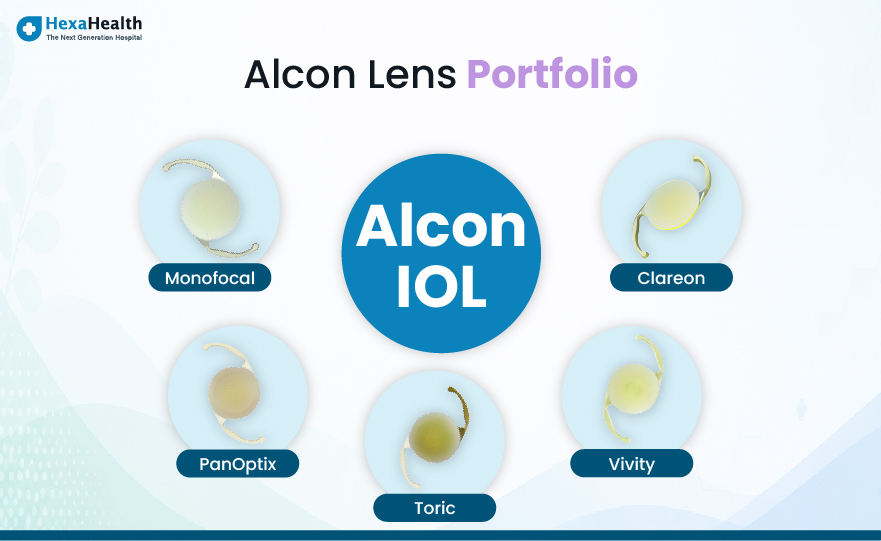
- Types of Alcon IOL Lenses in India
- Lens Comparison: All Alcon IOLs at a Glance
- PanOptix vs Vivity: Which Should You Choose?
- Which Alcon Lens Do Eye Surgeons Usually Recommend?
- What Affects the Alcon Cataract Lens Price in India
- Key Takeaways
- Still Unsure Which Alcon IOL Is Right for You?
- Frequently Asked Questions
- References
How Much Does an Alcon IOL Cost in India?
The Alcon IOL price in India starts from approximately ₹30,000 per eye for a monofocal lens package and can go up to ₹70,000 or more for premium multifocal lenses. The Alcon lens price varies depending on the type of intraocular lens (IOL), the hospital, the surgeon's expertise, and whether the package includes cataract surgery.
Below is an overview of the approximate Alcon cataract lens price for different Alcon IOL models available in India.
| Alcon IOL Type | Model | Approximate Package Cost (Procedure + Lens, Per Eye) |
| Monofocal | AcrySof IQ | ₹30,000–₹50,000 |
| Monofocal Toric | AcrySof IQ Toric | ₹45,000–₹60,000 |
| Multifocal | AcrySof IQ ReSTOR | ₹50,000–₹70,00 |
What is an Alcon IOL Lens?
When a cataract develops, the eye's natural lens gradually turns cloudy, blocking light and blurring vision. During cataract surgery, the surgeon removes this cloudy lens and replaces it with an artificial one (an intraocular lens or IOL) that stays in your eye permanently.
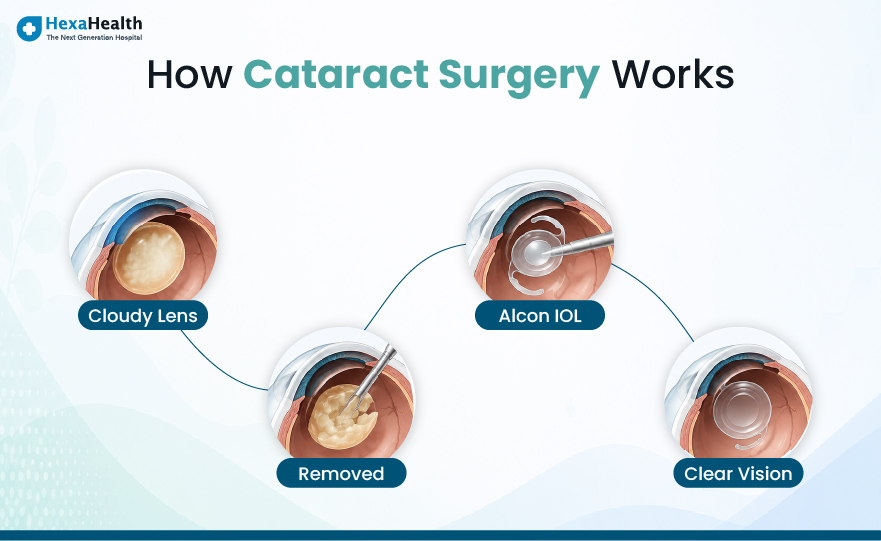
The IOL is not just a replacement part. It determines whether you will need glasses after surgery, how comfortable your vision is at night, and how satisfied you feel with the outcome years later. Choosing the right one matters.
Alcon is a US-based global eye care company with over 75 years in the field. Its IOLs are available in India under two product families:
AcrySof® IQ series: The established range, widely available across most Indian eye hospitals.
Clareon® platform: Alcon's newer premium-material range, available at select eye centres.
Why Choose Alcon?
Alcon's surgical IOLs are ranked number one in innovation in India, according to the company. Here is what backs that claim.
Alcon IOLs stand out among Indian ophthalmologists for a combination of reasons that go beyond brand reputation:
- Decades of clinical evidence: The AcrySof material has been studied in peer-reviewed journals for over three decades, with well-documented outcomes across millions of implantations globally.
- Hydrophobic acrylic material: Both the AcrySof and Clareon platforms use hydrophobic acrylic, a material that is stable, biocompatible, and engineered to remain clear in the eye for a lifetime without degrading.
- Aspheric optic design: Reduces common visual distortions (spherical aberrations) and improves contrast sensitivity, particularly in low-light conditions.
- Widest premium IOL range in India: From standard monofocal to diffractive trifocal to non-diffractive EDOF, Alcon offers one of the widest clinically validated premium IOL portfolios available in India.
- Global scale: Over 4 million PanOptix implants worldwide. US FDA approved. Used in over 140 countries.
- Consistent surgical delivery: Alcon's proprietary UltraSert® and AutonoMe® preloaded delivery systems provide reproducible implantation, reducing variability between surgeries.
Doctor Tip: When evaluating any IOL, ask your ophthalmologist how many times per month they implant the lens you are considering. Surgeons achieve consistently better outcomes with lenses they implant frequently, regardless of brand.
Alcon IOL Lens Price List in India: Detailed Breakdown (FY 2026)
The Alcon IOL lens price in India varies by lens type, hospital, city, and surgeon. The table below reflects typical package costs (procedure plus lens per eye) cross-referenced across verified Indian eye hospital sources for FY 2026.
| Alcon IOL Model | Type | Typical Package (Per Eye) | Who it is For |
| AcrySof IQ | Monofocal | ₹30,000–₹50,000 | Patients comfortable using reading glasses after surgery. |
| AcrySof IQ Toric | Monofocal Toric | ₹45,000–₹60,000 | Patients with astigmatism who are comfortable using reading glasses. |
| AcrySof IQ PanOptix | Trifocal | ₹70,000–₹1,50,000 | Patients who want to be largely glasses-free at near, intermediate, and distance. |
| PanOptix Toric | Trifocal Toric | ₹80,000–₹1,50,000 | Patients with astigmatism seeking maximum spectacle independence. |
| AcrySof IQ Vivity | Extended Depth of Focus (EDOF) | ₹70,000–₹1,50,000 | Patients who want reduced dependence on glasses with fewer night halos. |
| Clareon Monofocal | Clareon Platform | ₹55,000–₹75,000 | Patients who want Alcon's latest lens material with the simplicity of a monofocal lens. |
| Clareon PanOptix | Clareon Trifocal | ₹1,00,000–₹1,50,000 | Patients who want Alcon's latest Clareon platform with trifocal vision. |
| Clareon Vivity | Clareon EDOF | ₹1,00,000–₹1,50,000 | Patients who want the latest Clareon platform with EDOF vision and minimal halos. |
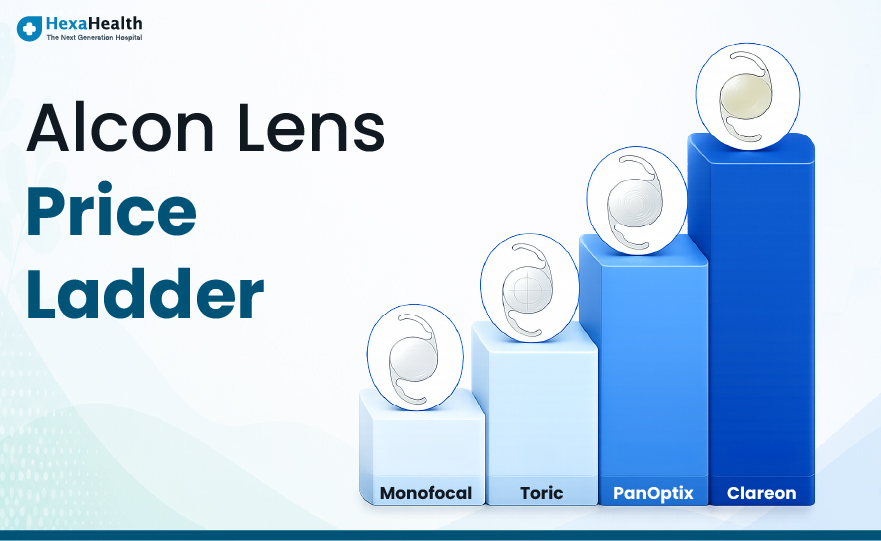
What is included in the typical package cost?
The per-eye figure above generally covers:
Surgeon fee and operation theatre charges
The IOL itself
Standard phacoemulsification (phaco) technique
Basic pre-op workup and post-op follow-up
Additional costs you may see billed separately:
Biometry and corneal topography: ₹3,000 – ₹10,000 (if not bundled)
Post-op eye drops (antibiotic, steroid, lubricant): ₹2,000 – ₹5,000
Laser-assisted surgery (FLACS): adds approximately ₹15,000 – ₹50,000 over standard phaco
Quick Fact: IOL pricing in India varies by hospital, city, surgeon, and surgery technique.
The figures in this article are indicative ranges cross-referenced across verified Indian eye hospital sources. Always ask your hospital for a written, itemised quote before confirming surgery. Before confirming surgery, ask your hospital four specific questions:
Is biometry included or billed separately?
Is this standard phaco, MICS, or laser-assisted surgery?
Are post-op medications and follow-up visits included?
Is the price quoted per eye or for both eyes together?
Types of Alcon IOL Lenses in India
AcrySofIQ Monofocal IOL
The most commonly implanted IOL in India. Corrects vision at one fixed distance (almost always set for distance) so you see clearly while driving, watching TV, or recognising faces. Reading glasses will be needed for close work such as reading, using a phone, or working at a computer.
Vision correction | Distance vision only |
Glasses after surgery | Reading glasses usually needed |
Night vision | Excellent, minimal risk of halos |
Insurance coverage | Covered under most insurance plans and government schemes |
Typical package cost | ₹30,000 – ₹50,000 per eye |
Pros:
Reliable, predictable, with a long safety record
No halos or glare at night
Works for all cataract grades
Eligible for insurance, PM-JAY, CGHS, and ECHS
Cons:
Reading glasses required after surgery
Does not correct astigmatism (standard version)
AcrySofIQ Toric IOL
Designed for patients who have astigmatism alongside their cataract. Astigmatism is an uneven corneal curve that blurs vision at all distances. The Toric lens corrects both the cataract and the cylindrical error in a single surgery, without a separate laser procedure.
If pre-op biometry shows a cylindrical power above 0.75 dioptres, most ophthalmologists recommend a Toric variant. Without it, residual astigmatism may mean you still need glasses for distance after surgery, which defeats part of the purpose of the operation.
Vision correction | Distance vision with astigmatism correction |
Glasses after surgery | Reading glasses usually needed |
Night vision | Excellent |
Typical package cost | ₹45,000–₹60,000 per eye |
Pros:
Corrects astigmatism and cataract in one surgery
Sharper, cleaner outcomes for patients with cylindrical power
Toric designs available across PanOptix and Clareon too
Cons:
Requires precise surgical alignment during implantation
Premium cost over standard monofocal typically not covered by insurance
AcrySofIQ ReSTOR Multifocal IOL
The ReSTOR is an earlier-generation multifocal lens. It has largely been replaced by the PanOptix Trifocal at most premium eye centres in India, which offers a stronger intermediate focal point better suited to modern screen use. The ReSTOR remains available at select hospitals and offers a mid-range price for patients seeking some glass independence.
The ReSTOR uses apodized diffractive technology to split light between two focal points (near and distance), reducing dependence on both reading and distance glasses. It does not have a dedicated intermediate focal point, which means laptop and phone use may still require glasses.
Vision correction | Near and distance vision |
Glasses after surgery | May still be needed for intermediate tasks (laptop, computer, phone) |
Night vision | Mild halos may occur |
Typical package cost | ₹50,000–₹70,000 per eye |
Pros:
Reduces dependence on both reading and distance glasses
More affordable than trifocal options
Cons:
No dedicated intermediate focal point for screen use
Largely superseded by PanOptix at leading centres
Halos at night possible
 AcrySofIQ PanOptix Trifocal IOL
Alcon's most popular premium lens and the world's most implanted trifocal IOL, with over 4 million implants globally. It corrects near (reading), intermediate (laptop and phone at 60 cm), and far (driving, outdoors) vision simultaneously.
The detail that sets the PanOptix apart from earlier multifocal designs is its intermediate focal point at 60 cm, the actual arm's length distance at which most people hold a phone or look at a laptop screen. Most competing IOLs place this at 80 cm, a distance that would only be comfortable for someone over 205 cm tall. This is not a marketing claim; it is a practical optical decision that directly affects daily usability.
The technology behind it is Alcon's ENLIGHTEN® Optical Technology, which channels 88% of available light across three focal zones and is less dependent on pupil size than older diffractive designs. In published clinical studies, 99% of PanOptix patients said they would choose the same lens again, with spectacle independence rates of 89–100%.
Vision correction | Near, intermediate (around 60 cm), and distance vision |
Glasses after surgery | Most patients are largely glasses-free |
Night vision | Halos may occur initially; most patients adapt within 3–6 months |
Typical package cost | ₹70,000 – ₹1,50,000 per eye |
Pros:
Full spectacle independence for most daily tasks
60 cm intermediate suited to modern screens and arm's-length reading
99% patient satisfaction in clinical studies
Available in Toric variant for patients with astigmatism
Cons:
Halos and rings around lights at night, especially in the first weeks
Neuroadaptation period of 3–6 months
Premium cost not covered by standard insurance
AcrySofIQ Vivity EDOF IOL
A fundamentally different category of lens. The Vivity is an Extended Depth of Focus (EDOF) IOL and the first non-diffractive EDOF design in the world. Rather than creating three discrete focal points the way a trifocal does, the Vivity produces a smooth, continuous range of vision from distance through intermediate, with functional near vision.
The technology is Alcon's X-WAVE™. Instead of splitting light (which causes halos), it stretches and shifts light to widen the visual range without the optical disturbances associated with diffractive lenses. The result is vision that feels more natural, particularly at night.
A useful way to think about it: the PanOptix switches on three distinct focal points; the Vivity gives you a dimmer-switch visual range. Both significantly reduce glass dependence, and the Vivity does it with fewer visual side effects.
Vision correction | Distance and intermediate vision, with functional near vision |
Glasses after surgery | May still need reading glasses for very fine print |
Night vision | Excellent, with significantly fewer halos than trifocal lenses |
Typical package cost | ₹70,000 – ₹1,50,000 per eye |
Pros:
Far fewer halos and glare than diffractive trifocal lenses
Preferred for patients who drive frequently at night
More natural visual quality in low light
Good option for patients with mild dry eye or history of LASIK
Near vision not as sharp as PanOptix for fine-print reading tasks
Reading glasses may still be needed occasionally
Clareon® Series: Alcon's Next-Generation Platform
The Clareon® is Alcon's most advanced lens material, available at select premium eye centres in India. The key difference from AcrySof is in the material itself: a new hydrophobic acrylic formulation with significantly lower rates of glistening and surface haze.
Glistening refers to microscopic water droplets that can form within a lens material over years. While clinically mild in most cases, glistening can affect long-term optical clarity in a small proportion of patients. The Clareon material has among the lowest glistening levels of any IOL tested in vitro.
Clareon Monofocal | Alcon's premium Clareon material with monofocal optics. Provides sharp distance vision with functional intermediate vision (up to 20/32 at ~66 cm). | ₹55,000–₹75,000 |
Clareon Toric | Clareon platform with built-in astigmatism correction for clearer distance vision. | ₹65,000–₹85,000 |
Clareon PanOptix | Trifocal lens on the advanced Clareon material, offering near, intermediate, and distance vision with improved long-term optical clarity. | ₹1,00,000–₹1,50,000 |
Clareon Vivity | Extended Depth of Focus (EDOF) lens using X-WAVE technology on the Clareon material for a continuous range of vision with fewer halos. | ₹90,000–₹1,50,000 |
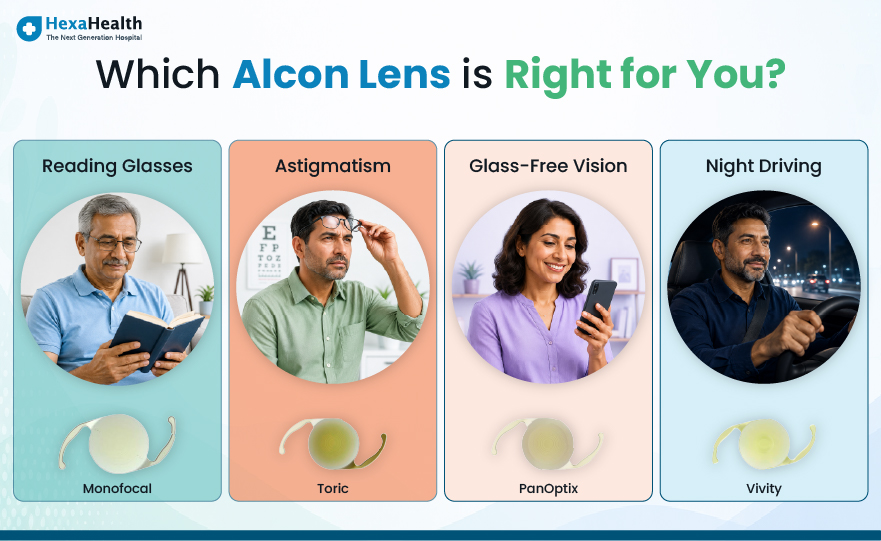
Lens Comparison: All Alcon IOLs at a Glance
| Alcon IOL | Vision Range | Glasses After Surgery | Night Vision | Best For | Typical Package (Per Eye) |
|---|---|---|---|---|---|
| AcrySof IQ Monofocal | Distance only | Reading glasses usually needed | Excellent | Budget-conscious patients; insurance-eligible | ₹30,000–₹50,000 |
| AcrySof IQ Toric | Distance + astigmatism correction | Reading glasses usually needed | Excellent | Patients with astigmatism | ₹45,000–₹60,000 |
| AcrySof IQ ReSTOR | Near and distance | May still need glasses for intermediate tasks | Mild halos may occur | Mid-range budget; reduced dependence on glasses | ₹50,000–₹70,000 |
| AcrySof IQ PanOptix | Near, intermediate, and distance | Most patients are largely glasses-free | Halos may occur initially | Patients seeking maximum spectacle independence | ₹70,000–₹1,50,000 |
| AcrySof IQ PanOptix Toric | Near, intermediate, and distance with astigmatism correction | Most patients are largely glasses-free | Halos may occur initially | Patients with astigmatism seeking maximum spectacle independence | ₹80,000–₹1,50,000 |
| AcrySof IQ Vivity | Distance to intermediate with functional near vision | May still need reading glasses for fine print | Excellent | Night drivers and glare-sensitive patients | ₹70,000–₹1,50,000 |
| Clareon PanOptix | Near, intermediate, and distance | Most patients are largely glasses-free | Halos may occur initially | Patients seeking a premium trifocal lens with advanced Clareon material | ₹1,00,000–₹1,50,000 |
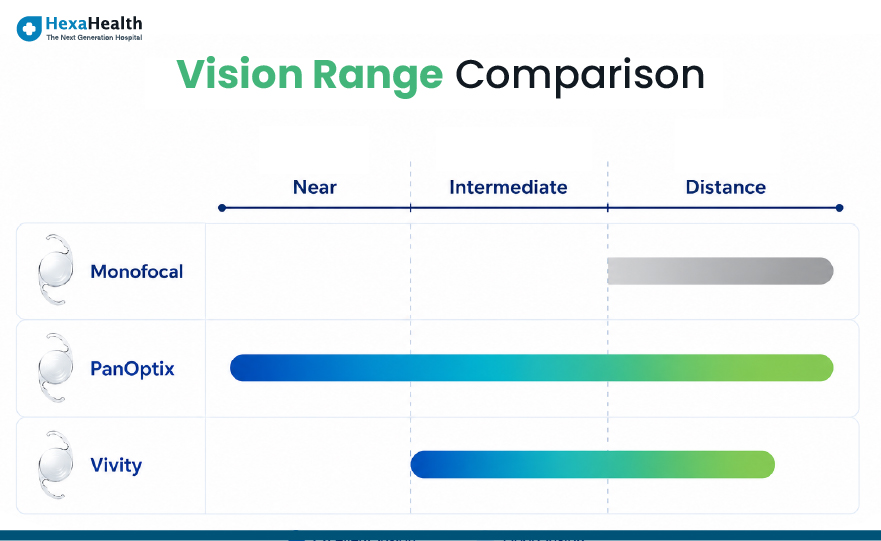
PanOptix vs Vivity: Which Should You Choose?
This is the most common comparison patients ask their ophthalmologist about. Both are premium Alcon IOLs that significantly reduce dependence on glasses, but they are designed for different priorities.
AcrySofIQ PanOptix | AcrySofIQ Vivity | |
|---|---|---|
Technology | Diffractive trifocal (ENLIGHTEN®) | Non-diffractive EDOF (X-WAVE™) |
Focal points | Three: near, intermediate (60 cm), far | Continuous range: distance through intermediate |
Near vision | Sharp; reads fine print comfortably | Functional; fine print may need glasses |
Night vision | Halos and rings common initially | Significantly fewer halos; preferred for night driving |
Adaptation period | 3–6 months neuroadaptation | Minimal adaptation needed |
Patient satisfaction | 99% would choose again¹ | High; preferred by patients sensitive to glare |
Best for | Complete spectacle independence | Visual quality and night comfort |
Typical package | ₹70,000 – ₹1,50,000 | ₹70,000 – ₹1,20,000 |
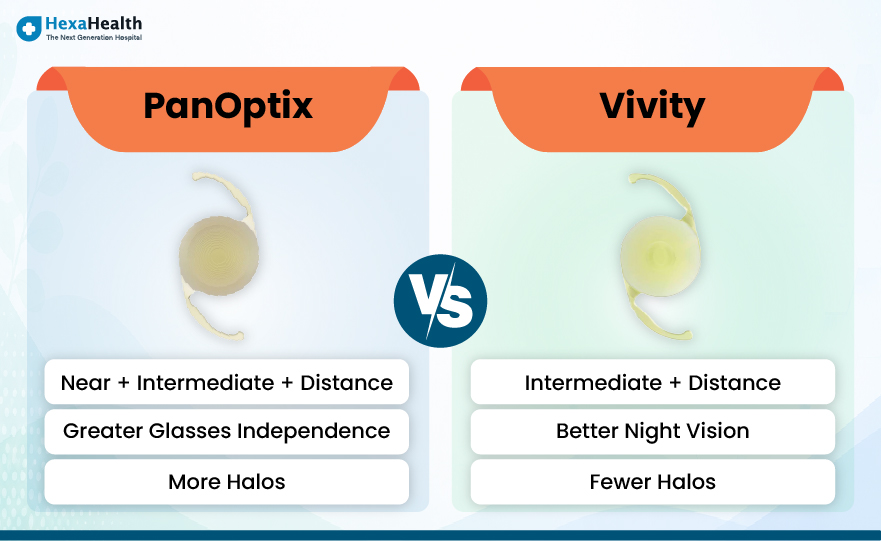 Doctor Tip: If you are choosing between PanOptix and Vivity, ask your surgeon whether they can help you understand what halos may look like after surgery. Some eye centres use simulation tools or visual aids to demonstrate this before you decide. Patients who feel comfortable with the possibility ofhalos often go on to be very satisfied with the PanOptix.
The straightforward way to think about it: If your primary goal is to be completely glass-free at all distances, the PanOptix is the stronger choice. If you drive frequently at night, are sensitive to halos, or work in high-contrast environments, the Vivity is worth a serious conversation with your surgeon.
Which Alcon Lens Do Eye Surgeons Usually Recommend?
Based on clinical practice patterns across leading Indian eye hospitals, ophthalmologists typically recommend:
AcrySofIQ Monofocal for patients with co-morbidities (dry eye, macular changes, retinal issues) where premium IOLs carry higher risk; for patients whose primary concern is cost; and for all insurance-covered or government-scheme cases.
AcrySofIQ PanOptix for healthy eyes with good tear film, patients under 70, and those with strong motivation to be glass-free at near, intermediate, and far distances.
AcrySofIQ Vivity for patients who are borderline candidates for a trifocal, such as those with mild dry eye, a history of LASIK, early macular changes, or high sensitivity to glare.
Toric variants whenever pre-op cylindrical power exceeds 0.75 dioptres, regardless of which lens category is chosen.
Clareon platform for patients at premium centres who prioritise long-term material durability and want Alcon's best-in-class optical material.
The recommendation is always individualised. Factors your surgeon weighs include corneal topography, pupil size, tear film health, lens density, axial length, and your stated lifestyle priorities.
No IOL is universally the best. The ideal lens depends on your eye measurements, retinal health, corneal condition, lifestyle, and personal expectations. What works well for one patient may not suit another.
Patient Scenario Guide: Which Alcon IOL Fits Your Life?
| Patient Profile | Likely Best Alcon Lens | Why |
|---|---|---|
| Retired, reads occasionally, budget-conscious | AcrySof IQ Monofocal | Reliable, insurance-covered, and requires no adaptation period. |
| Office worker, heavy laptop use (50s) | AcrySof IQ PanOptix | Provides clear near, intermediate (around 60 cm), and distance vision, making it ideal for screen-heavy work with minimal dependence on glasses. |
| Drives regularly at night | AcrySof IQ Vivity | Non-diffractive EDOF design offers excellent night vision with significantly fewer halos and glare. |
| Has astigmatism and wants to reduce dependence on glasses | AcrySof IQ PanOptix Toric | Corrects both cataract and astigmatism while providing near, intermediate, and distance vision. |
| Sensitive to glare or works outdoors | AcrySof IQ Vivity | EDOF technology reduces light disturbances and maintains good contrast sensitivity. |
| Covered under Ayushman Bharat / PM-JAY | AcrySof IQ Monofocal | Monofocal lenses are generally the option covered under government schemes. |
| Wants Alcon's most advanced long-term lens material | Clareon PanOptix | Combines advanced Clareon material with trifocal optics for excellent optical clarity and long-term performance. |
| Has mild dry eye and wants to reduce glasses | AcrySof IQ Vivity | Lower visual demands on the tear film than trifocal lenses and typically requires gentler neuroadaptation. |
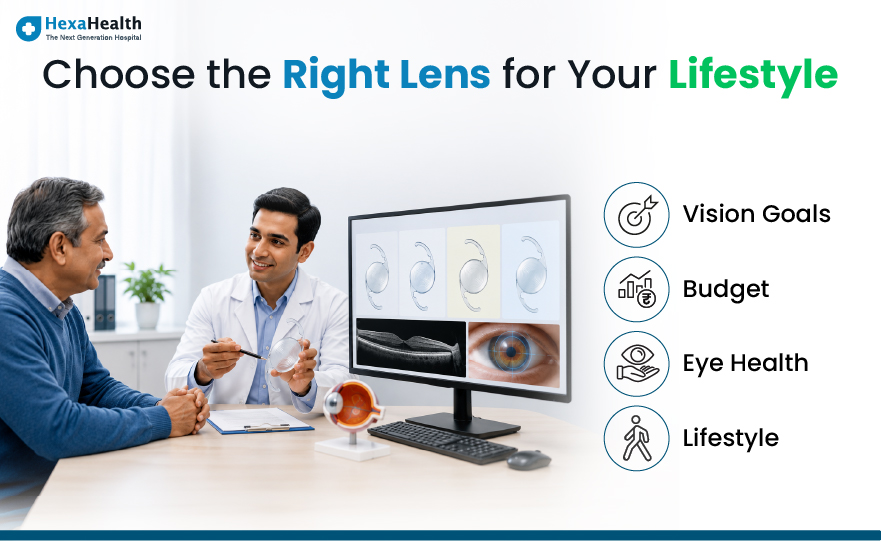
These are indicative scenarios only. Your ophthalmologist will assess corneal topography, pupil size, tear film, lens density, and lifestyle before making a recommendation.
How to Choose the Right Alcon IOL: What Your Doctor Will Ask
Step 1: What does your daily life look like after surgery?
Do you read extensively, spend hours on a laptop, or drive long distances? Or do you mainly watch television and are comfortable picking up reading glasses when needed? Your honest answer narrows down the lens category significantly.
Step 2: Do you have astigmatism?
Your surgeon will check this during pre-op biometry. Ifcylindrical power is above 0.75 dioptres, a Toric variant will give sharper results regardless ofthe lens category chosen.
Step 3: How important is being glass-free to you?
Fine with reading glasses for close work: Monofocal
Want to reduce glass use significantly but also sensitive to glare: Vivity (EDOF)
Want to be as glass-free as possible at all distances: PanOptix Trifocal
Step 4: How sensitive are you to light and night driving?
Ifyou are already bothered by glare from headlights or drive frequently at night, the Vivity's non-diffractive design is worth discussing with your surgeon before choosing a diffractive trifocal.
Step 5: What does your budget and insurance allow?
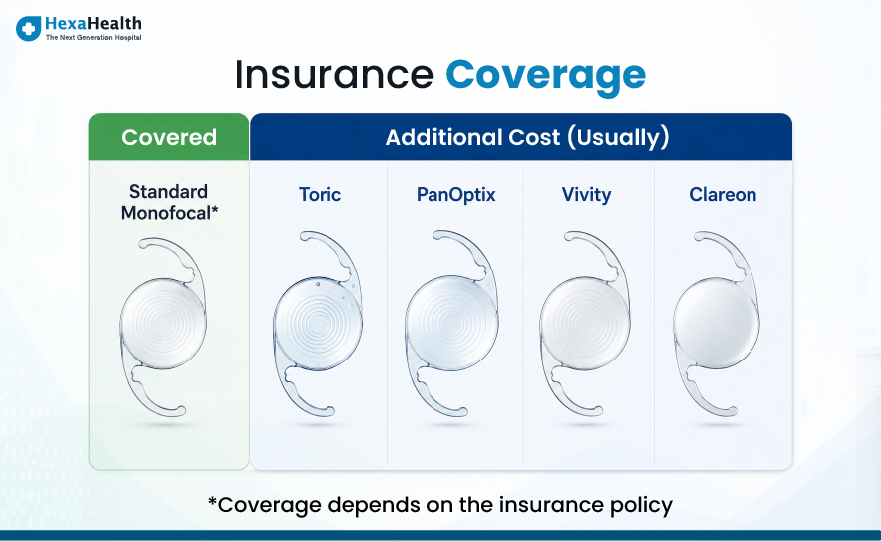
Most insurance policies and government schemes cover standard cataract surgery with a basic monofocal IOL. Premium Alcon lenses such as PanOptix, Vivity, Toric, and Clareon usually require an additional out-of-pocket payment. Coverage may vary by insurer and policy, so confirm with your insurer or hospital before surgery.
Alcon vs Other IOL Brands in India
Alcon is one of several internationally trusted IOL manufacturers. Here is an honest comparison:
| Brand | Country | Popular Models | Typical Package (Per Eye) | Known For |
|---|---|---|---|---|
| Alcon | USA | AcrySof IQ, PanOptix, Vivity, Clareon | ₹30,000–₹1,50,000 | Widest premium IOL portfolio, extensive clinical evidence, and PanOptix's 60 cm intermediate vision. |
| Johnson & Johnson | USA | Tecnis Monofocal, Tecnis Synergy, Tecnis Eyhance | ₹25,000–₹1,20,000 | Synergy offers excellent low-light and night vision; Eyhance provides enhanced monofocal depth of focus. |
| ZEISS | Germany | AT LISA tri, AT TORBI, CT LUCIA | ₹40,000–₹1,30,000 | Precision German optics with excellent contrast sensitivity. |
| Bausch + Lomb | USA | enVista, Akreos AO | ₹20,000–₹90,000 | Good biocompatibility with a long-established clinical track record. |
| Aurolab | India | Aurovue, Auroflex | ₹5,000–₹25,000 | Affordable lenses widely used in government hospitals and charitable eye care programmes. |
The right brand is not a universal answer. It depends on your eye, your surgeon's experience with a particular lens, and what the centre you have chosen regularly implants. Surgeons consistently achieve better outcomes with lenses they implant frequently.
Top Hospitals for Alcon IOL Surgery in India
Top Doctors for Alcon IOL Surgery in India
| Doctor's Name | Years of Experience | Recommended |
|---|---|---|
| Dr Meenal Lohia |
17 | 97% |
| Dr Sandeep Kataria |
31 | 97% |
| Dr Varun Gupta |
13 | 97% |
| Dr Sunanda Haldar |
10 | 97% |
| Dr Ashutosh Chaturvedi |
7 | 97% |
What Affects the Alcon Cataract Lens Price in India
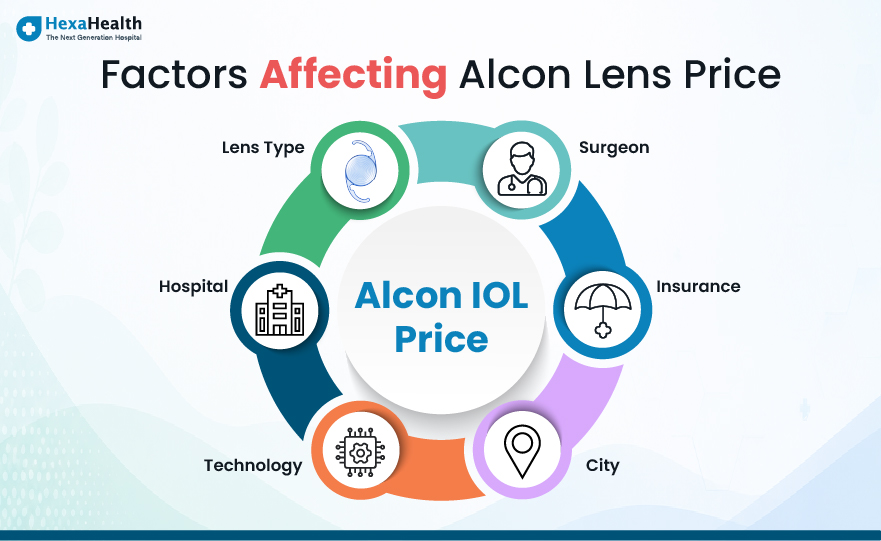
The Alcon cataract lens price depends on the type of IOL, hospital, city, surgeon's experience, and whether premium techniques such as FLACS are used. Iftwo hospitals quote very different prices for the same Alcon IOL, one or more ofthese variables is typically responsible:
City and hospital category: Corporate hospitals in metro cities (Delhi NCR, Mumbai, Bengaluru) typically charge more than private clinics in tier-2 cities, even for identical lenses.
Surgery technique: Standard phacoemulsification is the baseline. MICS is a smaller-incision refinement. Femto-laser-assisted surgery (FLACS) can add approximately ₹15,000 – ₹50,000 to the package.
Surgeon's seniority: Senior ophthalmologists and subspecialty IOL surgeons command higher professional fees.
Bilateral surgery: Each eye is billed separately. Some hospitals offer a bilateral discount, so ask specifically before confirming.
Package inclusions: An all-inclusive quote (biometry, medications, follow-up visits) may appear higher upfront but is often more transparent and cost-effective than a base price with add-ons.
Insurance and Government Scheme Coverage for Alcon IOLs
Most insurance policies and government schemes cover standard cataract surgery with a basic monofocal IOL. Premium Alcon lenses such as PanOptix, Vivity, Toric, and Clareon variants usually require an additional out-of-pocket payment. Coverage may vary by insurer and policy, so patients should confirm with their insurer or hospital before surgery.
| Scheme | What is Covered |
|---|---|
| Private Health Insurance | Standard monofocal IOL is typically covered. Premium lenses usually require an additional payment (top-up). Coverage varies by insurer and policy |
| Ayushman Bharat (PM-JAY) | Phacoemulsification cataract surgery with a basic foldable monofocal IOL is covered. Package value is typically around ₹25,000–₹30,000 per eye |
| CGHS | Standard cataract surgery with a monofocal IOL at empanelled hospitals. Many centres allow patients to pay the price difference (top-up) for a premium lens |
| ECHS | Standard cataract surgery with a monofocal IOL for eligible retired Armed Forces personnel at empanelled hospitals |
If you are on a government scheme and want a premium Alcon lens:
- Ask the empanelled hospital ifa patient-paid top-up is permitted
- Many hospitals allow you to pay the difference between the scheme amount and the premium lens cost
- Get this confirmed in writing before your surgery date is fixed
- Individual policy terms and TPA guidelines vary; always verify directly
Key Takeaways
Alcon IOL procedure costs in India in 2026 range from approximately ₹30,000 (Monofocal) to ₹1,50,000 (Clareon PanOptix) per eye.
The right lens depends on your vision goals, lifestyle, astigmatism status, sensitivity to glare, and budget, not on cost alone.
The AcrySofIQ PanOptix is one ofthe world's most widely used trifocal IOLs, with a 60 cm intermediate focal point and 99% patient satisfaction.¹
The AcrySofIQ Vivity is better suited to patients sensitive to halos or who drive frequently at night.
Most insurance policies and government schemes cover a standard monofocal IOL only. Premium lenses usually require an out-of-pocket payment; coverage varies by insurer and policy.
No lens delivers its best outcome without the right surgeon and a thorough pre-operative evaluation. Lens selection and surgical skill are equally important.
Still Unsure Which Alcon IOL Is Right for You?
Choosing the right Alcon IOL is an important decision that can affect your vision for years to come. At HexaHealth, our eye care coordinators help you navigate lens options based on your lifestyle, eye measurements, insurance eligibility, and budget, before you step into the OT.
We connect you with experienced ophthalmologists across Delhi NCR, Gurgaon, and Noida for a detailed, transparent pre-surgery lens counselling consultation with itemised pricing. No generic advice. Just a recommendation built around your eyes and your life.
Frequently Asked Questions
What is the price of Alcon IOL lens in India in 2026?
Alcon IOL lens price in India in 2026 ranges from approximately ₹30,000 for the AcrySof IQ Monofocal to ₹1,50,000 for the Clareon PanOptix Trifocal per eye, including the surgical procedure. Costs vary by hospital, city, and surgeon and should always be confirmed in a written quote.
 WhatsApp
Which Alcon lens is best for cataract surgery in India?
The best Alcon lens depends on your lifestyle, vision goals, and budget. The AcrySof IQ PanOptix Trifocal is the most popular premium choice for patients who want to be largely glass-free. The AcrySof IQ Monofocal is among the most widely implanted IOLs worldwide and remains the standard choice for patients comfortable with reading glasses seeking an insurance-covered option. Your ophthalmologist will recommend after a full pre-operative assessment.
What is the difference between AcrySofIQ Monofocal and PanOptix Trifocal?
The AcrySof IQ Monofocal corrects vision at one distance (usually far) and requires reading glasses for close tasks. The PanOptix Trifocal corrects near, intermediate (60 cm), and far vision simultaneously, making most patients largely glass-free. The PanOptix costs significantly more, is not typically covered by insurance, and involves an initial adaptation period during which halos around lights at night are common.
Is Alcon PanOptix worth the cost in India?
For patients with an active lifestyle involving reading, screen use, and driving, most ophthalmologists consider the PanOptix a worthwhile long-term investment. Clinical studies show 99% of patients would choose the same lens again, with spectacle independence rates of 89–100%.⁵ The higher upfront cost should be weighed against a lifetime of reduced dependence on glasses.
PanOptix or Vivity: Which is better?
They serve different priorities. The PanOptix is better ifyour primary goal is complete spectacle independence at all distances. The Vivity is better ifyou prioritise cleaner night vision, drive frequently after dark, or are sensitive to halos. Discuss both with your surgeon; the decision often comes down to your corneal health, tear film, and lifestyle.
How long does an Alcon IOL last?
Alcon IOLs are designed to be permanent. Both AcrySof and Clareon lens materials are stable and biocompatible, intended to last a lifetime without replacement in the vast majority of patients.
Can an Alcon IOL be replaced after surgery?
IOL exchange is technically possible but is a more complex and higher-risk procedure than the original surgery. It is only recommended in specific situations such as significant refractive error post-surgery, lens dislocation, or patient intolerance. Careful pre-operative assessment and lens selection is therefore essential.
Does the Alcon PanOptix cause halos and glare?
Yes. Halos and rings around lights at night are a known side effect of all diffractive trifocal lenses, including the PanOptix. Most patients adapt within 3–6 months through neuroadaptation. Patients with existing sensitivity to glare may be better suited to the Vivity EDOF, which uses non-diffractive X-WAVE technology and produces significantly fewer visual disturbances.
Is Alcon IOL covered under insurance in India?
Most insurance policies and government schemes cover standard cataract surgery with a basic monofocal IOL. Premium Alcon lenses (PanOptix, Vivity, Toric, Clareon) usually require an additional out-of-pocket payment. Coverage varies by insurer, policy, TPA, and hospital billing practices; always confirm with your insurer or hospital before surgery.
What surgery technique is used with Alcon IOLs?
Alcon IOLs are compatible with standard phacoemulsification (the most common technique in India), MICS (micro-incision cataract surgery), and femto-laser-assisted cataract surgery (FLACS). Your surgeon recommends the technique based on cataract grade, corneal health, and the lens chosen.
Which Alcon IOL is best for someone with astigmatism?
AnyAlcon Toric variant (AcrySof IQ Toric, PanOptix Toric, or Clareon Toric) corrects astigmatism alongside the cataract. Ifcylindrical power is greater than 0.75 dioptres, a Toric lens will generally give sharper results than a standard lens. Whether to choose a Toric Monofocal or Toric Trifocal depends on your glass independence goals and budget.
What is the difference between AcrySofPanOptix and Clareon PanOptix?
Both deliver the same trifocal optical design with a 60 cm intermediate focal point. The Clareon PanOptix is built on Alcon's newer lens material with significantly lower glistening levels and better long-term optical stability. Two-year clinical data shows comparable visual outcomes, with the Clareon material demonstrating improved clarity over time.
What is the Alcon Vivity EDOF IOL and who is it for?
The Vivity is Alcon's Extended Depth of Focus lens, using non-diffractive X-WAVE™ technology to provide a smooth visual range from distance to intermediate with functional near vision. It produces far fewer halos than trifocal lenses and is particularly suited to patients who drive frequently at night, those with mild dry eye or prior LASIK, and patients who want meaningful glass independence without the adaptation period of a trifocal lens.
How do I know if an Alcon IOL is genuine?
In India, genuine Alcon IOLs come with packaging that includes a product label, batch number, and expiry date. At reputed hospitals and eye centres, the surgeon or surgical team will typically show you the sealed IOL packaging before the procedure. If you have concerns, ask your hospital to confirm the lens model and batch number in writing before surgery. Purchasing cataract surgery through a verified, accredited hospital is the most reliable way to ensure you receive an authentic Alcon lens.
Is cataract surgery with an Alcon lens safe?
Cataract surgery with Alcon IOLs has a well-established global safety record. Alcon's AcrySof and Clareon materials are FDA-approved and used in over 140 countries. The surgery is one of the most performed elective procedures in the world, with very high success rates when performed by an experienced surgeon. As with any surgery, risks exist and should be discussed with your ophthalmologist before proceeding.
Which Alcon IOL is best for diabetic patients?
For patients with diabetes, the choice of IOL requires additional care. Diabetic patients are at higher risk of macular oedema and retinal complications after cataract surgery, which can affect the quality of visionwith premium multifocal lenses.
Most ophthalmologists recommend the AcrySof IQ Monofocal for patients with diabetic retinopathy or a history of macular changes, as it provides predictable distance vision without the contrast sensitivity demands of atrifocal or EDOF lens. For well-controlled diabetic patients without retinal involvement, premium IOLs may still be considered, but only after a thorough retinal evaluation and in consultation with both an ophthalmologist and a diabetologist.
The decision is always individualised based on overall diabetes control (including HbA1c), retinal status, and the stability of diabetic eye disease.
References
All the articles on HexaHealth are supported by verified medically-recognized sources such as; peer-reviewed academic research papers, research institutions, and medical journals. Our medical reviewers also check references of the articles to prioritize accuracy and relevance. Refer to our detailed editorial policy for more information.
- Singh, R. R. (2019). AcrySof IQ PanOptix intraocular lens versus extended depth of focus intraocular lens and trifocal intraocular lens: A clinical overview. Asia-Pacific Journal of Ophthalmology, 8(4), 335–339.

- Allan, B., Bhatt, U., & Beckingsale, P. (2021). Patient expectation, satisfaction and clinical outcomes with a new multifocal intraocular lens. Clinical Ophthalmology, 15, 4251–4260.
- Fernández-Vigo, J. I., Burgos-Blasco, B., & Gómez-de-Liaño, L. D. (2025). Comparison of two-year clinical and patient-reported outcome measures between AcrySof IQ and Clareon PanOptix multifocal intraocular lenses. American Journal of Ophthalmology.
- Centre for Sight. (2026). Cataract surgery cost in India: Compare prices by surgery type.
- EyeMantra. (2026, March 6). Cost of cataract surgery and IOLs in Delhi 2026
- Berdahl, J., Bala, C., Dhariwal, M., Rathi, H., Gupta, R., & Jin, G. (2022). Cost-benefit analysis of a trifocal intraocular lens versus a monofocal intraocular lens from the patient's perspective in the United States. PLOS ONE.
- Community Eye Health Journal South Asia. (2025, November 20). IOLs in India: How and where they are used. Vol. 38, No. 127, p. 13.
Last Updated on: 3 July 2026
Reviewer

Dr Jaideep Dhama is a well-known Ophthalmologist currently associated with Healthport Clinic. He has 24 years of experience in Ophthalmology and worked as an expert Ophthalmologist in different cities of India.
Docto...View More
Author

Dr Sania Datta
BDS (Panjab University) I MBA Hospital & Health Management (IIHMR Jaipur)
8 Years Experience
She is a high-impact healthcare management and medical content professional with enriching work experience in Parexel, HexaHealth Technologies, Apollo Munich, Credihealth and Fortis Hospital. Armed with deep and c...View More
Expert Doctors (10)


Ophthalmology,Anterior Segment/Cornea Ophthal...

2025+ Years
Experience

95%
Recommended





NABH Accredited Hospitals (5)



 Q9G5+G4F


 4.56/5( Ratings)
Latest Health Articles





Related Treatments