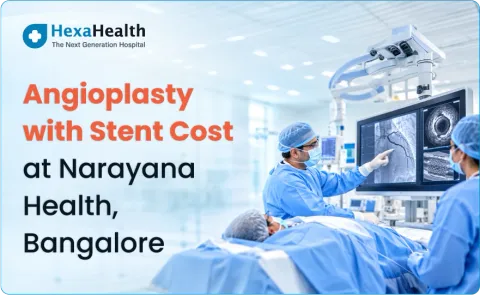
Angioplasty with Stent Cost at Narayana Health, Kolkata


Copy Link

 Medically Reviewed by Dr. Aman Priya Khanna

 WhatsApp Expert
Table of Contents
- Angioplasty Cost at Narayana Health, Kolkata: Hospital-wise Comparison
- How Much Does Angioplasty with One, Two, or Three Stents Cost?
- Types of Coronary Stents Used in Angioplasty
- Advanced Coronary Imaging Costs at Narayana Health, Kolkata
- Why Consider Narayana Hrudayalaya, Kolkata for Angioplasty?
- Interventional Cardiologists at Narayana Health, Kolkata
- How to Plan Angioplasty at Narayana Health, Kolkata Through HexaHealth
- Frequently Asked Questions
- References
The angioplasty cost in Narayana Hrudayalaya Kolkata starts at ₹90,000 for standard angioplasty in the General category at Narayana Multispeciality Hospital, Barasat. At Narayana Superspeciality Hospital, Howrah, the procedure starts at ₹90,190, while single-vessel angioplasty with a drug-eluting stent (PTCA-DES) starts at ₹1,15,000 at RN Tagore Hospital, Mukundapur.
Angioplasty costs depend on the procedure and stent requirements. Blockage complexity, room category, and additional expenses also affect pricing.
Coronary angioplasty, also known as percutaneous coronary intervention (PCI), is a minimally invasive procedure used to open narrowed or blocked arteries supplying blood to the heart. A balloon widens the affected artery, and a stent is commonly placed to maintain blood flow.
This guide covers angioplasty package charges, coronary stent prices, treatment options, cardiologists, and health insurance coverage at Narayana Health hospitals in Kolkata.

Angioplasty Cost at Narayana Health, Kolkata: Hospital-wise Comparison
Narayana Health offers angioplasty across its Kolkata-area hospitals. Treatment charges vary depending on the hospital, procedure, and accommodation category.
Hospital | Procedure | Starting Cost |
|---|---|---|
Single-vessel PTCA-DES | ₹1,15,000 | |
Standard angioplasty | ₹90,190 | |
Standard angioplasty | ₹90,000 |
These are General-category procedure charges. Since the starting packages represent different types of angioplasty, patients should compare similar procedures when reviewing hospital costs.
Angioplasty Cost at RN Tagore Hospital, Kolkata
Rabindranath Tagore International Institute of Cardiac Sciences (RTIICS), located in Mukundapur, provides coronary angiography, angioplasty, and complex cardiac interventions.
The single-vessel PTCA-DES cost starts at ₹1,15,000 in the General category. Charges vary according to the procedure and room category.
Angioplasty Charges at RN Tagore Hospital
Procedure | General | Semi-private | Twin Sharing | Private/Deluxe | Suite |
|---|---|---|---|---|---|
PTCA-DES, single vessel | ₹1,15,000 | ₹1,38,000 | ₹1,55,300 | ₹1,84,000 | ₹3,22,000 |
PTCA-DES, multivessel | ₹1,36,500 | ₹1,63,800 | ₹1,84,300 | ₹2,18,400 | ₹3,82,200 |
Primary angioplasty (Package 1) | ₹1,04,500 | ₹1,25,400 | ₹1,41,100 | ₹1,67,200 | ₹2,92,600 |
Primary angioplasty (Package 2) | ₹1,66,650 | ₹2,00,000 | ₹2,25,000 | ₹2,66,600 | ₹4,66,600 |
Angioplasty with IVUS | ₹1,20,500 | ₹1,44,600 | ₹1,62,700 | ₹1,92,800 | ₹3,37,400 |
Complex angioplasty | ₹2,28,200 | ₹2,73,800 | ₹3,08,100 | ₹3,65,100 | ₹6,39,000 |
PTCA stands for percutaneous transluminal coronary angioplasty, while DES refers to a drug-eluting stent.
Single-vessel angioplasty treats one coronary artery, whereas multivessel angioplasty involves more than one artery. Primary angioplasty is performed urgently during certain heart attacks, while complex procedures may require specialised equipment.
Angioplasty Cost at Narayana Superspeciality Hospital, Howrah
Narayana Superspeciality Hospital, located near Nabanna on Andul Road, provides interventional cardiology, cardiac surgery, and critical-care services. The standard angioplasty cost starts at ₹90,190, while single-vessel PTCA-DES costs ₹1,33,970 in the General category.
Procedure | General | Semi-private | Private |
|---|---|---|---|
Standard angioplasty | ₹90,190 | ₹1,30,800 | ₹1,53,300 |
PTCA-DES, single vessel | ₹1,33,970 | ₹1,94,270 | ₹2,27,770 |
PTCA-DES, multivessel | ₹1,51,190 | ₹2,19,290 | ₹2,57,090 |
Primary angioplasty | ₹1,06,720 | ₹1,54,700 | ₹1,81,400 |
Angiogram and angioplasty, same sitting | ₹1,13,000 | ₹1,63,900 | ₹1,92,100 |
Angioplasty with IVUS | ₹1,17,350 | ₹1,70,200 | ₹1,99,500 |
Complex single-vessel PTCA with ROTA/IVUS | ₹1,65,000 | ₹2,39,300 | ₹2,80,500 |
Complex multivessel PTCA with ROTA/IVUS | ₹1,86,000 | ₹2,69,700 | ₹3,16,200 |
The hospital provides different packages for routine and complex coronary interventions.
IVUS helps cardiologists assess coronary artery dimensions and guide stent placement. Rotational atherectomy (ROTA) may be used to modify heavily calcified plaque before stenting.
Angioplasty Cost at Narayana Multispeciality Hospital, Barasat
Narayana Multispeciality Hospital, located on Jessore Road, Barasat, provides cardiac investigations and coronary intervention services. The standard angioplasty cost starts at ₹90,000 in the General category.
Procedure | General | Semi-private | Private |
|---|---|---|---|
Standard angioplasty | ₹90,000 | ₹1,08,000 | ₹1,35,000 |
Coronary angiogram | ₹15,500 | ₹18,600 | ₹23,300 |
Radial angiogram | ₹16,500 | ₹19,800 | ₹24,800 |
Balloon angioplasty | ₹95,000 | ₹1,14,000 | ₹1,42,500 |
Complex single-vessel PTCA with ROTA/IVUS | ₹1,11,400 | ₹1,33,700 | ₹1,67,100 |
Coronary angiography identifies narrowed or blocked coronary arteries, while angioplasty treats blockages requiring catheter-based intervention.
A radial angiogram uses an artery in the wrist. Balloon angioplasty widens a narrowed artery using an inflatable balloon, with stent placement depending on the treatment plan.
How Much Does Angioplasty with One, Two, or Three Stents Cost?
The cost of angioplasty with one, two, or three stents depends on the number of coronary arteries treated, the type of stents used, and the complexity of the blockages.
At Narayana Superspeciality Hospital, Howrah, single-vessel DES angioplasty costs ₹1,33,970, while multivessel DES angioplasty costs ₹1,51,190 in the General category.
Angioplasty Cost Comparison by Number of Stents
Number of Stents | Applicable Treatment | Package Cost |
|---|---|---|
One stent | Single-vessel angioplasty | ₹1,33,970 |
Two stents | Single-vessel or multivessel angioplasty | ₹1,33,970–₹1,51,190 |
Three stents | Single-vessel or multivessel angioplasty | ₹1,33,970–₹1,51,190 |
These amounts represent the applicable single-vessel and multivessel procedure packages, not separate fixed prices for each stent count.
One stent may be used to treat a single blockage, while two or three stents may be needed for multiple or lengthy blockages. Multiple stents can be placed within one artery or across different arteries.
The final cost depends on the procedure package, stent requirements, implant charges, and additional medical expenses.
Coronary Stent Price in India (2026)
A coronary stent is a small mesh tube placed inside a narrowed artery to maintain blood flow after angioplasty. The National Pharmaceutical Pricing Authority (NPPA) regulates coronary stent prices in India.
Stent Category | Maximum Price Per Stent |
|---|---|
Bare-metal stent (BMS) | ₹10,762.15 |
Drug-eluting stent (DES) | ₹39,186.03 |
Prices exclude applicable GST.
Cost of Multiple Drug-Eluting Stents
Number of DES | Combined Maximum Implant Price |
|---|---|
One | ₹39,186.03 |
Two | ₹78,372.06 |
Three | ₹1,17,558.09 |
These amounts represent the maximum combined implant prices, not the complete angioplasty cost. Separate stent charges may apply depending on the hospital package.
Types of Coronary Stents Used in Angioplasty
Different coronary stents are available to treat narrowed or blocked arteries. The cardiologist selects the device according to the patient's coronary anatomy and treatment requirements.
Drug-Eluting Stents (DES): Release medication that reduces excessive tissue growth inside the treated artery. They help lower the risk of re-narrowing and are commonly used in coronary angioplasty.
Bare-Metal Stents (BMS): Provide structural support without a drug coating. They have a higher risk of re-narrowing than modern drug-eluting stents, so their routine use has declined.
Bioresorbable Coronary Scaffolds: Provide temporary support to the artery and gradually break down after implantation. Their use depends on clinical suitability and device availability.
Coronary Stent Manufacturers
Common coronary stent manufacturers include Abbott, Medtronic, Boston Scientific, Meril Life Sciences, and Biotronik. The choice of stent depends on artery size, blockage characteristics, and device availability.
What is Included in the Angioplasty Package at Narayana Hrudayalaya, Kolkata?
Angioplasty packages cover services associated with the selected procedure. However, certain implants, investigations, and additional medical services may involve separate charges.
Package Inclusions and Exclusions
Expense | Package Coverage |
|---|---|
Angioplasty procedure | Included in the selected procedure package |
Cardiologist's professional fees | Depends on package inclusions |
Catheterisation laboratory | Depends on package inclusions |
Coronary stents | Depends on the selected package |
Routine investigations | Depends on package inclusions |
Specialised balloons and guidewires | May involve additional charges |
IVUS, OCT, or FFR | Depends on the selected procedure |
Blood products | May be charged separately |
Hospital accommodation | Depends on package and room category |
Additional hospital stay | May increase expenses |
Follow-up consultations | Depends on hospital policy |
Patients should review the applicable package inclusions and exclusions to understand which expenses are covered and which may be billed separately.
Factors Affecting Angioplasty Cost at Narayana Health, Kolkata
Several clinical and hospital-related factors influence the total angioplasty cost. These include:
Number of Stents: Using two or more coronary stents may increase implant-related expenses.
Number of Arteries Treated: Multivessel angioplasty may involve different procedure charges than single-vessel treatment.
Blockage Complexity: Long, severe, or heavily calcified blockages may require specialised devices and advanced techniques.
Type of Angioplasty: Standard, primary, and complex angioplasty have different charges.
Choice of Hospital: Treatment costs vary across Narayana Health hospitals in Mukundapur, Howrah, and Barasat.
Room Category: General, semi-private, private, and other accommodation categories have different charges.
Advanced Coronary Assessment: IVUS, OCT, or FFR may be required in selected cases.
Additional Consumables: Specialised balloons, guidewires, and other devices may increase expenses.
Length of Hospital Stay: Longer hospitalisation or intensive monitoring may increase the bill.
Additional Medical Care: Complications or associated health conditions may require further investigations, medicines, or procedures.
The cardiologist determines the appropriate treatment according to coronary anatomy, blockage severity, and the patient's overall health.
Advanced Coronary Imaging Costs at Narayana Health, Kolkata
Advanced coronary assessments help cardiologists evaluate blockages and plan selected angioplasty procedures.
IVUS, OCT, and FFR Charges at Narayana Health, Kolkata
Investigation | RN Tagore, Kolkata | NSH Howrah | NMH Barasat |
|---|---|---|---|
IVUS | ₹37,500 | ₹25,000 | ₹25,000 |
IVUS HD | ₹40,000 | ₹28,000–₹35,000 | ₹28,000–₹35,000 |
Cardiac OCT | ₹80,000 | ₹70,000–₹80,000 | ₹71,400 |
FFR | ₹25,000 | ₹25,000–₹35,000 | ₹25,000–₹35,000 |
These charges apply when the investigations are billed separately.
- IVUS (Intravascular Ultrasound): Uses ultrasound to examine coronary arteries from within.
- OCT (Optical Coherence Tomography): Provides detailed images of artery walls and stent placement.
- FFR (Fractional Flow Reserve): Measures pressure differences to assess whether narrowing restricts blood flow.
Not every patient requires advanced coronary imaging. The cardiologist recommends these investigations according to clinical findings.
What is Coronary Angioplasty?
Coronary angioplasty is a minimally invasive procedure used to treat narrowed or blocked coronary arteries.
These arteries supply oxygen-rich blood to the heart muscle. Fatty plaque deposits can narrow the arteries and reduce blood flow, causing coronary artery disease.
During angioplasty, the cardiologist guides a catheter into the affected artery and inflates a balloon to widen the blockage. A coronary stent is commonly placed to maintain the opening.
Angioplasty can improve blood flow and relieve symptoms such as chest pain. However, it does not eliminate the underlying coronary artery disease. Medicines, lifestyle changes, and regular follow-up remain important after treatment.
When is Coronary Angioplasty Recommended?
Cardiologists may recommend angioplasty when significant coronary artery narrowing affects blood flow to the heart.
Common indications include:
Certain heart attacks requiring emergency coronary intervention
Acute coronary syndromes involving significant coronary blockages
Persistent angina despite appropriate medical treatment
Significant coronary narrowing associated with reduced blood flow
Selected cases of complex coronary artery disease
Not every coronary blockage requires angioplasty. Some patients benefit from medicines and lifestyle changes. Others may need coronary artery bypass grafting (CABG). The cardiologist recommends treatment based on symptoms, coronary anatomy, and overall medical condition.
Types of Coronary Angioplasty and Their Costs
Different angioplasty techniques are used depending on the location, severity, and complexity of coronary blockages.
The main types include:
Standard Coronary Angioplasty: Uses a balloon catheter to widen a narrowed coronary artery. A stent is commonly placed to maintain blood flow.
Primary Angioplasty: An emergency procedure performed during certain heart attacks to restore blood flow and reduce heart muscle damage.
Angiogram and Angioplasty in the Same Sitting: Combines coronary angiography and angioplasty during one catheterisation session when a blockage requires treatment.
Angioplasty with IVUS: Uses intravascular ultrasound to assess artery dimensions, evaluate blockages, and guide stent placement.
Angioplasty with OCT: Uses optical coherence tomography to examine plaque characteristics, artery structure, and stent expansion.
Angioplasty with FFR: Uses pressure measurements to assess whether a coronary narrowing significantly restricts blood flow before deciding on treatment.
Complex Coronary Angioplasty: Treats difficult blockages, including heavily calcified arteries, long lesions, and blockages involving multiple vessels or branches. Specialised techniques such as rotational atherectomy may be required.
Coronary Angioplasty Cost Comparison at Narayana Hrudayalaya, Kolkata
The following table compares General-category charges for different coronary angioplasty procedures across Narayana Health hospitals in Kolkata.
Procedure | Cost |
|---|---|
Standard coronary angioplasty | ₹90,000–₹90,190 |
Primary angioplasty | ₹1,04,500–₹1,66,650 |
Angiogram with angioplasty | ₹1,13,000 |
Angioplasty with IVUS | ₹1,17,350–₹1,20,500 |
Complex coronary angioplasty | ₹1,65,000–₹2,28,200 |
Complex multivessel angioplasty with ROTA/IVUS | ₹1,86,000 |
Charges depend on the hospital, procedure, and room category. Additional implant and medical expenses may apply.
Tests Required Before Coronary Angioplasty
Before recommending angioplasty, the cardiologist may advise investigations to assess heart function, identify coronary blockages, and plan treatment.
Common tests include:
Electrocardiogram (ECG): Records the heart's electrical activity and helps detect abnormal rhythms or signs of reduced blood flow.
Echocardiography (2D Echo): Uses ultrasound to assess heart structure, pumping function, and valve function.
Blood Tests: Evaluate kidney function, blood count, blood sugar, and other important health parameters.
Cardiac Troponin Test: Helps identify heart muscle injury, particularly when a heart attack is suspected.
Coronary Angiography: Uses contrast dye and X-ray imaging to identify narrowed or blocked coronary arteries.
CT Coronary Angiography: Provides detailed coronary artery images in selected patients.
Fractional Flow Reserve (FFR): Determines whether certain coronary narrowings significantly restrict blood flow.
IVUS or OCT: Provides detailed intracoronary imaging to assess blockages and guide treatment in selected cases.
Not every patient requires all these investigations. The cardiologist recommends tests based on symptoms, medical history, and clinical findings.
Patients can also explore the angiography test cost at Narayana Health Kolkata to understand related investigation expenses.
How is Coronary Angioplasty Performed?
Coronary angioplasty is performed in a cardiac catheterisation laboratory. The main steps include:
Step 1: Patient Preparation
The medical team reviews the patient's investigations, medicines, and overall health. Local anaesthesia is administered at the catheter insertion site.
Step 2: Catheter Insertion
A thin catheter is inserted through an artery in the wrist or groin and guided towards the coronary arteries.
Step 3: Identifying the Blockage
Contrast dye and X-ray imaging help the cardiologist identify the affected coronary artery and blockage.
Step 4: Balloon Inflation
A guidewire is passed across the narrowed section. A balloon catheter is then inflated to widen the artery.
Step 5: Stent Placement
A coronary stent is commonly expanded at the treated section to help maintain blood flow.
Step 6: Final Assessment
The cardiologist checks the treatment result and blood flow. Additional imaging may be used when required.
Step 7: Recovery and Monitoring
The patient is monitored after the procedure. The medical team checks heart rhythm, symptoms, and the catheter insertion site.
Recovery After Coronary Angioplasty
Recovery after coronary angioplasty depends on the procedure and the patient's medical condition.
Many patients undergoing uncomplicated planned angioplasty can leave the hospital within one or two days. Patients treated for heart attacks or complications may require longer monitoring.
Precautions After Angioplasty
Patients should follow these precautions during recovery:
Take prescribed antiplatelet medicines regularly.
Do not stop cardiac medicines without medical advice.
Follow instructions for caring for the catheter insertion site.
Resume physical activity according to the cardiologist's recommendations.
Attend scheduled follow-up consultations.
Manage blood pressure, diabetes, and cholesterol.
Avoid smoking and follow a heart-healthy diet.
Seek immediate medical attention for severe chest pain, breathlessness, significant bleeding, fainting, or sudden weakness.
Why Consider Narayana Hrudayalaya, Kolkata for Angioplasty?
Narayana Health provides comprehensive cardiac care across its hospitals in Mukundapur, Howrah, and Barasat. These hospitals offer access to experienced interventional cardiologists, advanced diagnostic facilities, cardiac catheterisation laboratories (Cath Labs), and critical-care services for patients requiring coronary angioplasty.
Key facilities and services include:
Advanced Cardiac Infrastructure: The hospitals have dedicated cardiac catheterisation laboratories and operation theatres to support coronary angiography, angioplasty, stent placement, and cardiac surgery.
Experienced Cardiac Specialists: Interventional cardiologists and cardiac surgeons provide treatment for coronary artery disease, including routine and complex coronary interventions.
Advanced Coronary Interventions: Facilities support single-vessel and multivessel angioplasty, primary angioplasty for certain heart attacks, and complex procedures using techniques such as intravascular ultrasound (IVUS) and rotational atherectomy (ROTA).
Comprehensive Diagnostic Services: ECG, echocardiography, treadmill testing, CT imaging, and coronary angiography help cardiologists assess heart function, identify blockages, and plan treatment.
Emergency and Critical-Care Support: Emergency departments, intensive care units, and cardiac monitoring facilities support patients requiring urgent intervention and post-procedure observation.
Multiple Hospital Locations: With facilities in Mukundapur, Howrah, and Barasat, patients can choose a hospital based on location, specialist availability, treatment requirements, and accommodation preferences.
These facilities enable Narayana Health to provide cardiac evaluation, coronary interventions, and post-treatment care across its Kolkata-area hospitals. The choice of hospital depends on the patient's medical condition, procedure requirements, and specialist availability.
Interventional Cardiologists at Narayana Health, Kolkata
Interventional cardiologists specialise in catheter-based cardiovascular procedures, including coronary angiography, angioplasty, and stent placement.
Cardiologist | Hospital | Area of Expertise |
|---|---|---|
RN Tagore Hospital | Coronary angioplasty and intracoronary imaging | |
RN Tagore Hospital | Coronary angioplasty and complex interventions | |
Narayana Superspeciality Hospital, Howrah | Complex and multivessel coronary interventions | |
Narayana Superspeciality Hospital, Howrah | Coronary angioplasty and catheterisation | |
Narayana Multispeciality Hospital, Barasat | Coronary angiography and primary PCI | |
Narayana Multispeciality Hospital, Barasat | Coronary interventions and cardiac imaging |
Cardiologist selection depends on the patient's condition and treatment needs. Patients can also explore the top cardiologists in Kolkata for additional specialist information.
Does Health Insurance Cover Angioplasty at Narayana Hospital, Kolkata?
Yes, health insurance may cover medically necessary coronary angioplasty at Narayana Health, Kolkata. Coverage can include hospitalisation, procedure charges, coronary stents, medicines, and other eligible treatment expenses.
The amount covered depends on the insurance policy, available sum insured, hospital network eligibility, and approved expenses.
Private and Family Health Insurance
Individual health insurance, family floater plans, and employer-provided policies may cover coronary angioplasty and stent placement.
Before treatment, patients should check:
Sum insured: The maximum amount available under the policy.
Cashless eligibility: Whether the selected hospital is part of the insurer's network.
Pre-authorisation: Approval requirements for planned hospitalisation.
Waiting periods: Restrictions applicable to pre-existing conditions.
Stent coverage: Whether coronary stents and specialised devices are covered.
Room rent limits: Restrictions on accommodation and related charges.
Co-payment and exclusions: Expenses payable by the patient.
Ayushman Bharat PM-JAY
The Ayushman Bharat Pradhan Mantri Jan Arogya Yojana (PM-JAY) provides eligible families with health coverage of up to ₹5 lakh per family per year for approved hospitalisation treatments.
Coronary angioplasty and stent placement may be covered under applicable cardiac treatment packages. Patients should confirm beneficiary eligibility, hospital empanelment, and treatment approval.
Swasthya Sathi Scheme
The Swasthya Sathi Scheme provides eligible beneficiaries in West Bengal with cashless hospitalisation benefits of up to ₹5 lakh per family per year. Angioplasty coverage depends on approved treatment packages, beneficiary eligibility, and hospital participation.
CGHS and Employer Health Schemes
The Central Government Health Scheme (CGHS) and employer-sponsored health schemes may cover angioplasty for eligible government employees, pensioners, and corporate employees.
Coverage depends on the applicable scheme, approved treatment rates, and hospital arrangements.
How to Get Cashless Angioplasty at NH, Kolkata
Cashless angioplasty allows eligible patients to receive treatment without paying the entire approved hospital bill upfront.
The process generally involves:
Check hospital eligibility: Confirm whether the selected Narayana Health hospital accepts the insurance policy.
Submit documents: Provide insurance details, identification, prescriptions, and medical reports.
Request pre-authorisation: The hospital submits the proposed treatment and expenses to the insurer.
Receive approval: The insurer confirms the eligible coverage.
Undergo treatment: The hospital performs angioplasty according to the approved treatment plan.
Settle additional expenses: Pay any charges excluded from insurance coverage.
For emergency angioplasty, the hospital may initiate the approval process according to the insurer's emergency admission rules. Emergency treatment should not be delayed while waiting for insurance approval.
Patients can connect with HexaHealth for assistance with hospital coordination, insurance verification, and cashless treatment procedures.
How to Plan Angioplasty at Narayana Health, Kolkata Through HexaHealth
Planning angioplasty involves medical evaluation, hospital selection, and understanding treatment expenses.
Step 1: Consult a Cardiologist
Schedule a consultation with an interventional cardiologist to discuss symptoms, medical history, and previous investigations.
Step 2: Complete the Required Investigations
Undergo coronary angiography and other recommended cardiac tests to identify blockages and assess treatment requirements.
Step 3: Understand the Treatment Options
Discuss angioplasty, medicines, and other suitable treatment approaches. Understand the number of coronary arteries requiring intervention.
Step 4: Select the Hospital
Explore Narayana Health hospitals in Mukundapur, Howrah, and Barasat based on specialist availability, cardiac facilities, and treatment requirements.
Step 5: Review the Treatment Cost
Request a detailed hospital quotation covering:
Angioplasty procedure and package charges
Number, type, and price of coronary stents
Catheterisation and additional imaging requirements
Room category and expected hospital stay
Medicines, consumables, and other medical expenses
Insurance coverage and expected out-of-pocket expenses
Step 6: Check Insurance Coverage
Verify policy eligibility, cashless hospital availability, and pre-authorisation requirements.
Step 7: Plan Treatment Through HexaHealth
Connect with HexaHealth for assistance with cardiologist consultations, hospital coordination, treatment expenses, insurance processes, and admission arrangements.
GET FREE CONSULTATION
Conclusion
Before proceeding with treatment, patients evaluating angioplasty cost in Narayana Hrudayalaya, Kolkata should consult an interventional cardiologist to confirm the procedure required, number and type of stents, and need for advanced techniques such as IVUS or rotational atherectomy.
Once the treatment plan is finalised, request a detailed package breakdown from the selected hospital in Mukundapur, Howrah, or Barasat. Check stent charges, additional expenses, and cashless insurance eligibility before admission.
Connect with HexaHealth to schedule a cardiologist consultation, compare hospital packages, understand insurance coverage, and coordinate angioplasty admission at Narayana Health, Kolkata.
Other Cardiac Procedure Costs at Narayana Health, Kolkata
Explore the costs of other cardiac procedures at Narayana Health, Kolkata:
Disclaimer: Treatment costs may vary depending on the procedure, implants, room category, and additional medical requirements. Final charges depend on the patient's condition and treatment received.
Consult the treating cardiologist for personalised medical guidance. Patients experiencing symptoms of a heart attack require immediate emergency medical attention.

Frequently Asked Questions
What is the angioplasty with stent cost at RN Tagore Hospital, Kolkata?
Single-vessel PTCA-DES starts at ₹1,15,000 in the General category. Additional implants and medical services may increase the final bill.
What is the starting angioplasty cost at Devi Shetty Hospital, Kolkata?
Standard angioplasty starts at ₹90,000 at Narayana Multispeciality Hospital, Barasat, and ₹90,190 at Narayana Superspeciality Hospital, Howrah. At RN Tagore Hospital, single-vessel PTCA-DES starts at ₹1,15,000.
Does the Narayana Health angioplasty package include stent charges?
Stent coverage depends on the selected hospital package. Separate implant charges may apply if coronary stents are not included.
What is the difference between single-vessel and multivessel angioplasty?
Single-vessel angioplasty treats one coronary artery, while multivessel angioplasty treats more than one. The number of stents may differ from the number of arteries treated.
Does primary angioplasty cost more than planned angioplasty?
Primary angioplasty has separate procedure charges and does not always cost more than planned angioplasty. The cost depends on the hospital, procedure, and medical requirements.
Is IVUS or OCT necessary for every angioplasty?
No. IVUS and OCT are used in selected cases to assess coronary arteries and guide stent placement. The cardiologist determines whether they are required.
How long does angioplasty take?
Uncomplicated angioplasty often takes approximately 30 minutes to two hours. Complex procedures may require additional time.
Does health insurance cover angioplasty and coronary stents at Narayana Hrudayalaya, Kolkata?
Many health insurance policies cover medically necessary angioplasty and eligible coronary stents. Coverage depends on policy terms, hospital eligibility, and approved expenses.
Which additional expenses should patients check before angioplasty?
Patients should review stent charges, specialised consumables, additional imaging, medicines, room category, and hospital stay. Insurance exclusions may also affect out-of-pocket expenses.
What is the stent surgery cost in Narayana Hrudayalaya, Kolkata?
The cost depends on the selected hospital, angioplasty procedure, and number of coronary stents required. At RN Tagore Hospital, single-vessel PTCA-DES starts at ₹1,15,000 in the General category. Additional implant and medical charges depend on the applicable package.
How can I find an interventional cardiologist for angioplasty at RN Tagore Hospital?
Patients can consult interventional cardiologists at RN Tagore Hospital, including Dr Ayan Kar and Dr Kashinath Ghosh Hazra. Specialist selection should depend on the patient's heart condition, procedure requirements, and doctor availability.
What is the heart stent surgery price in Narayana Hrudayalaya, Kolkata?
The heart stent surgery cost in Narayana Health, Kolkata depends on the selected hospital and procedure. At RN Tagore Hospital, single-vessel PTCA-DES starts at ₹1,15,000 in the General category. Additional stent and medical charges depend on the applicable package.
References
All the articles on HexaHealth are supported by verified medically-recognized sources such as; peer-reviewed academic research papers, research institutions, and medical journals. Our medical reviewers also check references of the articles to prioritize accuracy and relevance. Refer to our detailed editorial policy for more information.
- Narayana Health. Rabindranath Tagore International Institute of Cardiac Sciences, Kolkata [Internet]. Bengaluru: Narayana Health; [cited 2026 Nov 12].

- Narayana Health. Narayana Superspeciality Hospital, Howrah [Internet]. Bengaluru: Narayana Health; [cited 2026 Nov 12].
- Narayana Health. Narayana Multispeciality Hospital, Barasat [Internet]. Bengaluru: Narayana Health; [cited 2026 Nov 12].
- National Pharmaceutical Pricing Authority. Notification for revision in ceiling prices of coronary stents based on Wholesale Price Index [Internet]. New Delhi: Department of Pharmaceuticals, Government of India; 2026 [cited 2026 Nov 12].
- American Heart Association. Cardiac catheterization and coronary angioplasty [Internet]. Dallas: American Heart Association; [cited 2026 Nov 12].
- National Heart, Lung, and Blood Institute. Coronary angioplasty and stents [Internet]. Bethesda: National Institutes of Health; [cited 2026 Nov 12].
- European Society of Cardiology. 2024 ESC guidelines for the management of chronic coronary syndromes [Internet]. Sophia Antipolis: European Society of Cardiology; 2024 [cited 2026 Nov 12].
- American Heart Association. 2025 ACC/AHA/ACEP/NAEMSP/SCAI guideline for the management of patients with acute coronary syndromes [Internet]. Dallas: American Heart Association; 2025 [cited 2026 Nov 12].
- National Health Authority. Ayushman Bharat Pradhan Mantri Jan Arogya Yojana (AB PM-JAY) [Internet]. New Delhi: Government of India; [cited 2026 Nov 12].
- Government of West Bengal. Swasthya Sathi Scheme [Internet]. Kolkata: Government of West Bengal; [cited 2026 Nov 12].
Last Updated on: 12 November 2026
Reviewer

Dr. Aman Priya Khanna
MBBS, DNB General Surgery, FMAS, FALS Bariatric, MNAMS General Surgery, FIAGES
14 Years Experience
Dr Aman Priya Khanna is a leading National Board-certified Laparoscopic, GI, and Bariatric Surgeon in Ahmedabad with 14+ years of experience and over 4,500+ successf...View More
Author

With over 6 years of experience in content creation, branding, and social media marketing, she creates audience-focused content that drives engagement and strengthens digital presence. For the past 4 years, she has...View More
Expert Doctors (10)


Vascular and Interventional Radiology,Cardiot...

31+ Years
Experience

96%
Recommended


Cardiothoracic and Vascular Surgery,Paediatri...
56+ Years
Experience
98%
Recommended



NABH Accredited Hospitals (6)



 804/2, 805/2, E Ward




 4.56/5( Ratings)

Latest Health Articles