Echo Test Price in Manipal Hospital 2026 - Types and Costs


Copy Link
Written by Kirti, last updated on 3 April 2026| min read
Quick Summary
- Patients often feel anxious about echo tests (echocardiograms) as they suggest a cardiologist found potential heart concerns, despite the test itself being comfortable.
- An echocardiogram is a cardiac ultrasound that uses high-frequency sound waves to create real-time moving images of the heart.
- There are six distinct types of echocardiograms, each ordered for different clinical reasons and having a unique price point.
- Knowing the specific type of echo test is crucial to prevent unexpected billing surprises, especially regarding prices at hospitals like Manipal.
Table of Contents
- What is an Echo Test and Why Does Manipal Have Dedicated Echo Cardiologists?
- Echo Test Price in Manipal Hospital — All Types
- 2D Echo Test Cost in Manipal Hospital, Bangalore 2026
- Echo Medical Test Price in India — How Manipal Compares
- What Determines the Echo Test Cost at Manipal Hospital
- How to Prepare for Your Echo Test at Manipal Hospital
- Key Echocardiography Report Parameters — What Your Cardiologist is Measuring
- When Should You Get an Echo Test at Manipal Hospital?
- Frequently Asked Questions
- References
An echo test is one of those investigations that patients are often anxious about not because it is uncomfortable (it isn't), but because the cardiologist who ordered it clearly found something concerning enough in the ECG or clinical examination to want a closer look at the heart. Understanding the echo test price at Manipal Hospital, what the test involves, and what different types of echo reveal is exactly what this guide covers.
The term "echo test" is colloquially used for any echocardiogram — a cardiac ultrasound that uses high-frequency sound waves to create real-time moving images of the heart. But there are six meaningfully different types of echocardiogram, each ordered for different clinical reasons, each with a different price point. Knowing which type you've been referred for (or which type your condition actually requires) prevents unpleasant billing surprises at Manipal's cardiology desk.
What is an Echo Test and Why Does Manipal Have Dedicated Echo Cardiologists?
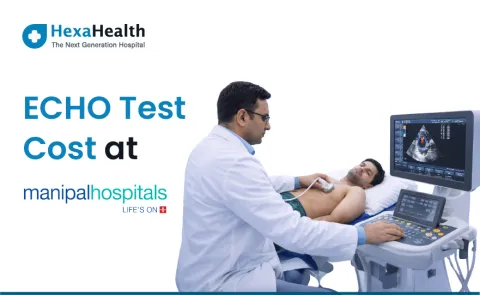
An echocardiogram (echo medical test) is a cardiac ultrasound. It uses a transducer (a handheld probe) pressed against the chest, coated in conductive gel, to send ultrasound waves through the chest wall into the heart. These waves bounce off heart structures and return as electrical signals that are converted into real-time moving images on a monitor. No radiation is involved. The test takes approximately 15–30 minutes for a standard transthoracic echo at Manipal, and the report is typically issued within 30 minutes of the procedure.
What separates a Manipal echo from a scan at a stand-alone diagnostic centre is that Manipal's cardiology departments employ dedicated echo cardiologists — clinicians who specialise specifically in interpreting cardiac ultrasound alongside interventional cardiologists, electrophysiologists, cardiovascular surgeons, and paediatric cardiologists. An echo result that reveals a structural abnormality, valve disease, or reduced ejection fraction at Manipal feeds directly into a cardiac team that can act on it the same day, in the same institution.
What an echo actually shows?
The echocardiogram is the most information-dense non-invasive cardiac test available. In a single 15–30 minute session, it measures the size of all four heart chambers, the thickness and movement of every segment of the heart muscle, the function of all four valves (whether they are narrowed or leaking and by how much), the ejection fraction (how efficiently the heart pumps), the presence of fluid around the heart (pericardial effusion), and blood flow patterns through the cardiac chambers. No other routine test provides this breadth of structural and functional cardiac information without inserting a catheter.

Echo Test Price in Manipal Hospital — All Types
The slightly higher pricing at Manipal Hospitals compared with standalone diagnostic labs reflects specialist echo cardiologist interpretation, direct integration with the cardiac intervention team, and the ability to arrange immediate follow-up if anything abnormal is detected.
- 2D Echocardiogram (TTE — standard): The most common heart ultrasound used to assess heart structure, pumping function, valve movement, and blood flow. The test usually takes 15–20 minutes and does not require any preparation.
- 2D Echo with Colour Doppler: Adds colour-flow mapping to a standard echo, helping doctors identify valve leaks, abnormal blood flow, or narrowing within the heart. It generally takes 20–30 minutes and requires no preparation.
- 3D Echocardiogram: Provides a more detailed three-dimensional view of the heart, especially useful for complex valve problems and surgical planning. The scan typically takes 25–35 minutes and does not require preparation.
- Transesophageal Echo (TEE): Uses a thin probe passed through the food pipe to obtain much clearer images of the heart, especially the valves and back chambers. It is often recommended when a regular echo is not detailed enough. The procedure takes around 30–45 minutes plus recovery time, and patients need to fast for 6 hours and come with an escort.
- Stress Echocardiogram (Treadmill + Echo): Combines an echocardiogram with exercise on a treadmill to see how the heart performs under stress. It is commonly used to investigate chest pain or suspected blocked arteries. The appointment usually lasts 45–60 minutes, and patients should wear comfortable footwear and have only a light meal beforehand.
- Dobutamine Stress Echocardiogram: Similar to a stress echo, but instead of exercising, a medication is used to make the heart work harder. This is usually done for patients who cannot walk on a treadmill. The test takes 45–60 minutes, with preparation depending on the cardiologist’s instructions.
- Fetal Echocardiography: A specialised ultrasound performed during pregnancy to assess the baby’s heart structure and function. It is generally recommended if there is a concern about congenital heart disease. The scan takes around 30–45 minutes and usually needs no preparation, though mild hydration may sometimes help.
- Emergency Echocardiogram (bedside/ER): Performed urgently in the emergency room or ICU to quickly evaluate serious heart problems such as chest pain, heart failure, or low blood pressure. It usually takes 10–15 minutes and does not require preparation.
* Prices are market benchmarks for NABH-accredited private tertiary hospitals. Confirm current pricing with your specific Manipal unit before attending. TEE, stress echo, and fetal echo are charged additionally from any same-day ECG or consultation fee.
Unsure which type of echo you've been referred for, or want to confirm the exact price at your nearest Manipal unit before booking? Talk to a HexaHealth Care Expert (free). We confirm pricing, explain your referral, and book priority appointments at your chosen Manipal cardiology unit.
2D Echo Test Cost in Manipal Hospital, Bangalore 2026
The 2D echo test cost at Manipal Hospital Bangalore is consistent across the network for a standard transthoracic echo. Every Manipal Bangalore unit — Old Airport Road, Whitefield, Yeshwanthpur, Jayanagar, Millers Road, Hebbal, and more has confirmed echocardiogram as a listed cardiology service. The most advanced echo capabilities (TEE, stress echo, 3D echo) are most reliably available at the larger units.
Manipal Unit (Bangalore) | Echo Types Available | 2D Echo + Doppler Price | Standout Cardiac Capability |
|---|---|---|---|
Old Airport Road (Flagship) | 2D, 3D, Doppler, TEE, Stress, Fetal, Emergency | ₹3,340 – ₹4,500 | Full adult + paediatric cardiac surgery. TAVI, LAA closure, EP ablation, complex PCI, FFR/IVUS/OCT, CTO intervention |
2D, Doppler, TEE, Stress, Fetal, CT cardiac, Cardiac MRI, Holter, CPET | ₹3,000 – ₹4,500 | Most comprehensive confirmed non-invasive cardiology service list in Bangalore. TEE + stress echo explicitly listed. AICD/CRT implantation. Fetal cardiology. | |
2D, Doppler, Holter, ECG, Stress | ₹3,000 – ₹4,000 | Dedicated echo cardiologists, electrophysiologists, interventional cardiologists. EP ablation including 3D ablation. Structural heart interventions. | |
2D, Doppler, ECG, Holter, TMT | ₹2,500 – ₹4,000 | One of Bangalore's largest cardiac specialty centres. CABG, angioplasty, open heart surgery, EP ablation, structural heart. Echo cardiologists on team. | |
2D, Doppler, ECG, Holter, TMT | ₹2,500 – ₹3,800 | Confirmed: echocardiogram, Holter, TMT, coronary angiogram, emergency PCI, cardiac device implantation, open heart surgery, EP ablation. | |
2D, Doppler, ECG, Holter | ₹2,500 – ₹3,500 | Standard echo available for routine cardiac diagnostic workup. Complex cases handled at Old Airport Road or Whitefield. |
HexaHealth recommendation for Bangalore echo: For a routine 2D echo or Doppler for symptoms like chest pain, breathlessness, or palpitations — any Manipal unit near you is appropriate and will provide the same 30-minute report turnaround. For TEE (needing oesophageal access), stress echo (treadmill or dobutamine), fetal echo (specialist paediatric cardiology backup needed), or 3D echo for pre-surgical valve planning — go to Whitefield (which explicitly lists TEE and stress echo) or Old Airport Road (full cardiac surgical backup). HexaHealth books priority appointments at whichever unit is correct for your test type.
2D Echo Test Cost at Manipal Hospital, Delhi NCR 2026
The 2D echo test cost at Manipal Hospital Delhi NCR is broadly consistent across units for a standard transthoracic echocardiogram. Key Manipal facilities in this region — Dwarka (Delhi), Gurugram, and Ghaziabad — all offer echocardiography as part of their cardiology services. However, advanced echo capabilities (TEE, stress echo, 3D echo, fetal echo) are more reliably available at the larger, flagship units with full cardiac infrastructure.
| Manipal Unit (Delhi NCR) | Echo Types Available | 2D Echo + Doppler Price | Standout Cardiac Capability |
|---|---|---|---|
| Dwarka (Delhi — Flagship NCR Unit) | 2D, Doppler, TEE, Stress, 3D Echo, Fetal, Emergency | ₹3,000 – ₹4,500 | Full-scale cardiology & cardiac surgery program. Structural heart interventions, complex PCI, electrophysiology (EP), advanced imaging. Best-equipped NCR unit. |
| Gurugram | 2D, Doppler, ECG, Holter, TMT | ₹2,500 – ₹4,000 | Strong non-invasive cardiology setup. Ideal for initial evaluation (chest pain, palpitations, breathlessness). Advanced cases referred to Dwarka. |
| Ghaziabad | 2D, Doppler, ECG, Holter | ₹2,500 – ₹3,800 | Routine diagnostic echo services. Suitable for basic cardiac workup. Complex imaging and interventions referred to Dwarka. |
2D Echo Test Cost at Manipal Hospital, Kolkata 2026
The 2D echo test cost at Manipal Hospital in Kolkata is generally consistent across units for a standard transthoracic echocardiogram.
Most centres offer routine echocardiography, while advanced tests like TEE, stress echo, and 3D echo are concentrated at larger units.
Your choice of hospital should depend not just on cost, but on the type of echo and level of cardiac care required.
| Manipal Unit (Kolkata) | Echo Types Available | 2D Echo + Doppler Price | Standout Cardiac Capability |
|---|---|---|---|
| Salt Lake (Flagship Kolkata Unit) | 2D, Doppler, TEE, Stress, 3D Echo, Fetal, ECG, Holter | ₹3,000 – ₹4,500 | Primary advanced cardiology centre in Kolkata. Full non-invasive + interventional cardiology support. TEE and stress echo available. Best for comprehensive cardiac evaluation and follow-up. |
| Mukundapur | 2D, Doppler, TEE, Stress, ECG, Holter, TMT | ₹3,000 – ₹4,200 | Strong multi-specialty unit with advanced cardiac diagnostics. Supports complex cases with access to interventional cardiology and imaging. |
| Dhakuria | 2D, Doppler, ECG, Holter | ₹2,500 – ₹3,800 | Suitable for routine echocardiography and basic cardiac workup. Convenient for South Kolkata patients. |
| Broadway | 2D, Doppler, ECG, Holter | ₹2,500 – ₹3,800 | Standard echo services available. Good for initial diagnosis and follow-up scans. Complex cases referred to larger units. |
| EM Bypass (General Reference Unit) | 2D, Doppler, ECG, Holter, TMT | ₹2,500 – ₹4,000 | Covers routine to moderately advanced diagnostics. Works closely with Mukundapur unit for higher-end cardiac care. |
2D Echo Test Cost at Manipal Hospital, Jaipur 2026
The 2D echo test cost at Manipal Hospital Jaipur is generally consistent for a standard transthoracic echocardiogram. Routine echocardiography is widely available, while advanced tests like TEE, stress echo, and 3D echo are offered at well-equipped units. Choosing the right centre depends on the type of echo advised and the level of cardiac expertise required for your case.
| Manipal Unit (Jaipur) | Echo Types Available | 2D Echo + Doppler Price | Standout Cardiac Capability |
|---|---|---|---|
| Vidhyadhar Nagar | 2D, Doppler, TEE, Stress, ECG, Holter, TMT | ₹2,500 – ₹4,000 | Primary Manipal unit in Jaipur with comprehensive cardiology services. Supports advanced diagnostics like TEE and stress echo with cardiologist supervision. |
Echo Medical Test Price in India — How Manipal Compares
Understanding where the echo test cost in Manipal Hospital sits relative to the broader Indian market helps patients appreciate whether they are paying a premium and what that premium buys. Here is the honest picture:
Facility Type | 2D Echo (TTE) | 2D Echo + Colour Doppler | TEE | What You Get |
|---|---|---|---|---|
Standalone Diagnostic Lab (Bangalore) | ₹1,200–₹2,500 | ₹1,500–₹3,000 | Often not available | Trained sonographer. Report sent to your cardiologist elsewhere. No same-session cardiology consultation. |
Mid-Tier Private Hospital | ₹1,800–₹3,000 | ₹2,000–₹3,500 | ₹5,000–₹8,000 | In-house cardiologist. Basic intervention capability. TEE availability varies. |
Manipal Hospital Bangalore | ₹2,500–₹4,000 | ₹3,340–₹4,500 | ₹6,000–₹12,000 | Dedicated echo cardiologists. Report in 30 min. Same-institution follow-through to intervention, surgery, EP, or structural heart if needed. |
Apollo / Fortis Premium Bangalore | ₹2,500–₹4,000 | ₹3,000–₹4,500 | ₹6,000–₹10,000 | Comparable pricing and quality to Manipal. No meaningful difference for routine echo. |
When the Manipal premium is worth it: For a straightforward 2D echo to check a mild murmur or pre-employment cardiac screening, the price difference between a diagnostic lab (₹1,500) and Manipal (₹3,500) is ₹2,000 — the cost of one cardiologist consultation. For a patient with established heart failure, a known valve lesion being monitored for surgery timing, suspected endocarditis, or pre-TAVI/valve repair planning — the Manipal premium buys a dedicated echo cardiologist interpretation that feeds directly into a team that can intervene the same day. That is a clinical value proposition, not just a brand premium.
What Determines the Echo Test Cost at Manipal Hospital
The final echocardiogram bill at Manipal Hospitals is influenced by more than just the type of test ordered — pricing varies according to the complexity of the study, the hospital branch, and whether additional cardiac imaging features are required.
- Echo Type: A standard 2D TTE is the least expensive because it requires no sedation, no fasting, no specialist escort, and minimal procedure time. TEE adds sedation, specialist equipment, monitoring, and recovery time. Stress echo adds a treadmill or drug infusion protocol. Each step up in complexity justifiably adds cost. The biggest price jump is from TTE (₹2,500–₹4,000) to TEE (₹6,000–₹12,000).
- Hospital Unit and City: Manipal Old Airport Road and Whitefield (larger units with more infrastructure) price slightly higher than smaller community units. Bangalore metro pricing runs approximately 10–20% higher than Manipal units in Mysore or other tier-2 cities for identical tests. The Vaidam-confirmed Manipal Bangalore price of USD 40–48 for colour Doppler echo reflects this metro premium.
- Echo Cardiologist vs Technician Report : At Manipal, the echocardiogram is performed by a trained cardiac ultrasound technician but interpreted and reported by a dedicated echo cardiologist — a clinician with specialised training in cardiac imaging. This interpretation adds cost over a standalone diagnostic lab report. The clinical value is significant: an echo cardiologist may catch subtle wall motion abnormalities, early valvulopathy, or diastolic dysfunction that a generalist radiologist would miss.
- Additional Modalities: If the cardiologist orders Colour Doppler alongside 2D, tissue Doppler for diastolic function assessment, contrast echo for difficult acoustic windows, or a combined echo+ECG on the same visit, each adds to the final bill. The most common add-on at Manipal is Colour Doppler (included in the ₹3,340–₹4,000 benchmark price) — pure 2D without Doppler is rarely ordered at a tertiary centre.
How to Prepare for Your Echo Test at Manipal Hospital
One of the genuinely reassuring things about a standard 2D echo at Manipal is that it requires almost no preparation at all. No fasting, no medication changes, no bowel preparation — you can eat, drink, and take your normal medications right up to the appointment. This is consistent across all Manipal Bangalore units. Here is what to do for each echo type:
Standard 2D Echo / 2D Echo with Colour Doppler: No preparation required. Eat, drink, and take medications as normal. Avoid wearing metallic accessories, jewellery, or belts — these will be removed before the test. Put your phone on silent. Female patients are examined by a female technologist at Manipal. Report issued within 30 minutes at reception.
Transesophageal Echocardiogram (TEE): Fast for at least 6 hours before the procedure (nothing to eat or drink except essential medications). Inform your cardiologist about any swallowing difficulties, GERD, or oesophageal disease. Mild sedation is given — you will not be able to drive home or make legal decisions for 12 hours after. Bring an escort. Your throat may be mildly uncomfortable for a few hours after the procedure.
Stress Echocardiogram (Treadmill): Wear comfortable, flat-soled shoes. Eat a light meal 2–3 hours before (avoid heavy food). Continue your regular medications unless your cardiologist specifically asks you to hold beta-blockers or rate-controlling drugs before the test (this affects the heart's stress response and is sometimes requested). Wear loose, comfortable clothing. The technician will take pre-exercise echo images, then you walk or run on a treadmill, and images are captured immediately at peak heart rate.
Fetal Echocardiography: Generally requires mild hydration — drink water before attending. No fasting or special preparation. The test is identical to a standard pregnancy ultrasound from the patient's perspective, but is interpreted by a specialist in congenital and fetal cardiology. At Manipal, the fetal medicine department and paediatric cardiology unit collaborate on fetal echo findings.
Key Echocardiography Report Parameters — What Your Cardiologist is Measuring
When you receive your Manipal heart ultrasound report, it will contain a series of measurements and assessments. Here are the most clinically significant parameters and their normal ranges, so you can understand what you're reading before your follow-up consultation:
Parameter | Normal Range (Adult) | Clinical Significance |
|---|---|---|
Ejection Fraction (EF) | 55% – 70% | Percentage of blood pumped out per beat. Below 40% = reduced EF (heart failure). 40–54% = mildly reduced. Above 55% = normal. |
Left Ventricular End Diastolic Diameter (LVEDD) | 35 – 58 mm | Size of the main pumping chamber when relaxed. Enlarged if > 58 mm — suggests volume overload, dilated cardiomyopathy, or severe AR/MR. |
Interventricular Septum (IVS) Thickness | 6 – 11 mm | Thickness of the wall between chambers. Above 12 mm suggests hypertrophy (hypertensive heart disease, HCM). Above 15 mm = significant hypertrophy. |
Left Atrial Size | 2.5 – 4.0 cm | Enlarged LA suggests chronic mitral valve disease, atrial fibrillation, or elevated left-sided filling pressures. > 4.5 cm = severely enlarged. |
Aortic Valve Area (AVA) | > 2.0 cm² | Reduced in aortic stenosis. Severe AS: < 1.0 cm². Determines timing of valve replacement (TAVI or surgical AVR at Manipal). |
Mitral Valve (E/A ratio) | E/A 0.75 – 1.5 | Doppler assessment of mitral inflow — detects diastolic dysfunction (impaired relaxation). Graded 1–3 for severity. Common finding in hypertension and ageing. |
Pericardial Effusion | Absent / Trivial | Fluid around the heart. Small amounts common post-cardiac surgery. Large effusion (> 2 cm) may cause tamponade and require drainage (pericardiocentesis at Manipal). |
Regional Wall Motion Abnormality (RWMA) | Absent | Segments of the heart wall moving abnormally or not at all — indicates prior heart attack (myocardial infarction) or active ischaemia. Critical finding requiring urgent intervention. |
Note: Normal ranges are approximate adult values. Your cardiologist interprets these in the context of your age, height, weight, body surface area, and clinical picture.
When Your Echo at Manipal Finds Something — What Comes Next
Most echocardiograms at Manipal come back with findings that require only medication adjustment, lifestyle modification, or a follow-up scan in 6–12 months. But when an echo reveals a significant abnormality, Manipal's integrated cardiac team means your pathway from diagnosis to treatment is seamless.
Here is how the most common abnormal cardiac scan findings translate into next steps:
Echo Finding | Likely Next Step at Manipal | Specialty |
|---|---|---|
Low Ejection Fraction (EF < 40%) | Heart failure workup — coronary angiogram to rule out ischaemia, BNP/NT-proBNP, cardiac MRI. Start GDMT (guideline-directed medical therapy). Consideration of ICD or CRT if EF remains low. | Interventional Cardiology / Electrophysiology |
Severe Aortic Stenosis (AVA < 1.0 cm²) | Cardiac CT for TAVI planning. Heart team discussion. Transcatheter Aortic Valve Implantation (TAVI) at Manipal — available at Old Airport Road and confirmed in angiogram blog. | Interventional Cardiology / Cardiac Surgery |
Significant Mitral Regurgitation / Stenosis | TEE for detailed valve anatomy. Consideration of Balloon Mitral Valvotomy (BMV) for MS, or surgical valve repair/replacement. Mitral clip (TMVR) in selected cases. | Cardiac Surgery / Interventional Cardiology |
Regional Wall Motion Abnormality | Urgent coronary angiogram. Emergency PCI if acute. Elective PCI or CABG planning if stable. Viability study (PET cardiac or cardiac MRI) if chronic MI. | Interventional Cardiology / Cardiac Surgery |
Large Pericardial Effusion | Echo-guided pericardiocentesis (drainage) if haemodynamically significant. Workup for cause — TB, malignancy, autoimmune. Cardiology inpatient admission at Manipal. | Cardiology / Cardiac Surgery |
ASD / VSD / PDA (Congenital Defect) | Haemodynamic evaluation. Device closure (ASD closure, VSD closure, PDA coil embolisation) — all confirmed at Manipal Bangalore units. | Paediatric Cardiology / Adult Congenital |
Left Atrial Thrombus (clot) on TEE | Anticoagulation for 3–6 months, repeat TEE to confirm clot resolution before any ablation or cardioversion. LAA closure procedure if recurrent. | Electrophysiology / Cardiology |
Normal Echo | Cardiac cause of symptoms excluded or assessed. Follow-up period determined by clinical risk. No further immediate cardiac investigation needed. | Cardiology / GP |
Your Echo Found an Abnormality. HexaHealth Navigates What Comes Next
A Manipal echo report with an abnormal ejection fraction, a valve finding, or a wall motion abnormality is the beginning of a clinical journey, not the end of one. Knowing which cardiologist to follow up with, whether you need an angiogram, and how to move from diagnosis to treatment quickly — without getting lost in Manipal's appointment system — is exactly what HexaHealth's Care Experts handle. We read your echo report with you, identify the right specialist, confirm costs, and get you seen fast.
When Should You Get an Echo Test at Manipal Hospital?
Echocardiograms are ordered more frequently than they need to be at stand-alone diagnostic centres where any symptom becomes an echo referral. At Manipal's cardiology department, the echo is a precision tool ordered for specific clinical reasons. Here are the situations where it is genuinely indicated:
- Unexplained Breathlessness : Progressive shortness of breath without a clear respiratory cause. Echo distinguishes cardiac breathlessness (low EF, valve disease, diastolic dysfunction) from pulmonary causes.
- Heart Murmur: An abnormal sound heard through a stethoscope. Echo determines whether the murmur is innocent (common in children and young adults) or represents valve disease requiring monitoring or intervention.
- After a Heart Attack: Post-MI echo assesses how much heart muscle was damaged, identifies wall motion abnormalities, and measures ejection fraction — which determines whether an ICD or specific medications are needed.
- High Blood Pressure (Monitoring): Chronic hypertension causes left ventricular hypertrophy and diastolic dysfunction — both detectable on echo before symptoms develop. Regular echo monitoring guides treatment intensification.
- Palpitations / Arrhythmia: Before ablation for atrial fibrillation or other arrhythmias, TEE is standard to exclude left atrial clots. Standard TTE also checks for structural causes of arrhythmia.
- Pre-Operative Cardiac Clearance: Before major non-cardiac surgery (orthopaedic, abdominal, vascular) in patients with known or suspected heart disease. Echo provides baseline cardiac function assessment for the anaesthetic team.
- Pregnancy with Cardiac History: Women with known valve disease, congenital heart conditions, or cardiomyopathy require echocardiographic monitoring during pregnancy. Fetal echo if there is a family history of congenital heart disease.
- Athletes with Symptoms: Chest pain, syncope, or excessive breathlessness during exercise in a young athlete. Echo screens for hypertrophic cardiomyopathy (HCM), arrhythmogenic cardiomyopathy (ARVC), and other conditions associated with sudden cardiac death.
Disclaimer: Echo test price in Manipal Hospital figures in this article are market benchmarks sourced from HexaHealth's patient cost database (₹1,000–₹3,500 national range), and published market data for NABH-accredited private hospitals in India. They are not official tariffs from Manipal Hospitals and may vary by unit, equipment, and cardiologist seniority. This article is for patient education only and does not constitute medical advice. Always consult a qualified cardiologist for diagnosis and treatment decisions.
HexaHealth confirms pricing, picks the right unit for your echo type, and books priority appointments — free
Frequently Asked Questions
What is the echo test price at Manipal Hospital?
The echo test price at Manipal Hospital varies by type. For the most commonly ordered test — a 2D echocardiogram with Colour Doppler — the Manipal Bangalore-specific benchmark from Vaidam Health is USD 40–48 (approximately ₹3,340–₹4,000). A standard 2D TTE without Doppler is slightly less at ₹2,500–₹3,500. Advanced tests cost more: TEE ranges ₹6,000–₹12,000; stress echo ₹5,000–₹9,000; fetal echo ₹3,500–₹7,000. HexaHealth's national 2D echo benchmark is ₹1,000–₹3,500 across all facility types — Manipal sits at the upper end of this range due to its dedicated echo cardiologist interpretation and immediate cardiac intervention backup. HexaHealth can confirm the exact current price at your specific Manipal unit before your appointment.
What is the 2D echo test cost at Manipal Hospital Bangalore specifically?
The 2D echo test cost at Manipal Hospital Bangalore for a standard transthoracic echo is approximately ₹2,500–₹4,000 depending on the specific unit and whether Colour Doppler is included (which it almost always is at a tertiary centre). The most precise published benchmark is USD 40–48 (≈ ₹3,340–₹4,000) for Echocardiography with Colour Doppler at Manipal Bangalore specifically.
This is consistent across Old Airport Road, Whitefield, Yeshwanthpur, Millers Road, and Jayanagar. The Manipal premium over a standalone diagnostic lab (₹1,200–₹2,000) reflects dedicated echo cardiologist interpretation and the ability to follow up abnormal findings in the same session with Manipal's cardiac team.
Is the echo test covered by health insurance at Manipal Hospital?
Yes — echocardiograms are covered by most Indian health insurance policies when they are medically indicated, i.e., ordered by a cardiologist or physician as part of an investigation for cardiac symptoms or a known cardiac condition. Coverage for purely preventive screening echoes (no symptoms, no prior history) varies by policy. Manipal Bangalore is empanelled with all major TPAs for cashless processing.
For an outpatient echo, you may need to pay out of pocket and claim reimbursement — cashless is more reliably available for inpatient investigations. Check with your TPA whether pre-authorisation is required for the specific echo type (TEE in particular, given its cost, may require approval). HexaHealth handles TPA coordination for you
How long does an echo test take at Manipal Hospital and when do I get my report?
A standard 2D echocardiogram at Manipal takes approximately 15–20 minutes for the procedure itself. The echo cardiologist reviews and reports within 30 minutes of the procedure — Manipal explicitly states "reports will be issued within 30 minutes post-procedure at the reception."
This same-session reporting means your cardiologist can review findings immediately in a follow-up consultation if needed. TEE takes 30–45 minutes for the procedure plus 30–60 minutes of post-sedation recovery. Stress echo adds 15–20 minutes of treadmill time to the standard echo protocol.
What is the difference between an ECG and a 2D echo? My doctor ordered both.
These are completely different tests measuring different aspects of heart function, and ordering both together is standard and correct clinical practice. An ECG (electrocardiogram) records the electrical activity of your heart — it detects rhythm disturbances, conduction defects, and electrical signs of ischaemia or prior heart attack. It takes 5 minutes, uses surface electrodes, and produces a tracing of electrical signals.
A 2D echo is a cardiac ultrasound — it creates moving visual images of the heart's anatomy, showing chamber sizes, wall motion, valve function, and ejection fraction. It takes 15–30 minutes and uses ultrasound waves. They are complementary: the ECG tells you how the heart's electrical system is working; the echo tells you how the structural pump is working. Together they provide a more complete cardiac assessment than either test alone.
What is a TEE and why might my Manipal cardiologist order it instead of a standard echo?
A Transesophageal Echocardiogram (TEE) involves passing a probe through the mouth down the oesophagus (food pipe) to obtain images from directly behind the heart. This approach bypasses the chest wall and ribs, which can obscure images in patients with obesity, COPD, or a broad chest. TEE is ordered when:
(1) a standard TTE shows insufficient image quality
(2) the cardiologist needs to visualise the left atrial appendage for clots before cardioversion or AF ablation
(3) assessing valve infections (endocarditis) where vegetation on valve leaflets needs to be confirmed
(4) evaluating prosthetic valve function, or
(5) planning structural heart procedures like TAVI or mitral clip
Manipal Whitefield explicitly lists TEE as a confirmed non-invasive cardiology service. The higher cost (₹6,000–₹12,000) reflects sedation, specialist equipment, monitoring, and recovery time.
My echo report says my ejection fraction is 50%. Should I be worried?
An ejection fraction of 50% sits at the lower end of the normal range (normal is 55–70%) and is described clinically as "mildly reduced" or "borderline." This finding alone is not an emergency — but it does warrant a conversation with your cardiologist about whether this represents a mild cardiomyopathy, prior unrecognised ischaemia, or simply a normal variant for your body size.
Your cardiologist at Manipal will look at this number alongside your symptoms, wall motion assessment, diastolic parameters, and clinical history to determine whether any treatment change or repeat scan is needed. A single echo value never tells the whole story — the pattern of findings across the report matters more than any single number. Book a HexaHealth consultation if you want help interpreting your Manipal echo report before your next cardiologist appointment.
Last Updated on: 3 April 2026
Disclaimer: The information provided here is for educational and learning purposes only. It doesn't cover every medical condition and might not be relevant to your personal situation. This information isn't medical advice, isn't meant for diagnosing any condition, and shouldn't replace talking to a certified medical or healthcare professional.
Author

With over 5 years of experience in content writing, SEO, marketing, branding, social media, and copywriting, she creates persuasive content that drives results. For the past 3 years, she has focused on medical cont...View More

 Open In App