

 Chat with Kidney Expert
Best Treatment for KIDNEY STONES in Bengaluru - URSL

Best Treatment for KIDNEY STONES in Bengaluru - URSL
 Painless Laser Procedure
100% Insurance Coverage
Get Surgery Today & Pay Later
Free Pick Up & Drop
No Doctor Consultation Charges
100+
JCI & NABH Hospitals
1,500+
Expert Doctors
8,000+
Happy Patients


Risks of Delayed URSL Treatment
- Increased pain and discomfort
- Progression of the condition
- Recurrent Urinary Tract Infections
- Blockage in Urinary Bladder
- Permanent Damage to Kidneys
Our Top Doctors

Dr Nipun Channabasappa Annigeri
Urologist

18 Years
Experience

100%
Positive Reviews
30 Patients already consulted this week

Dr Prathik R
Urologist
10 Years
Experience
99%
Positive Reviews
36 Patients already consulted this week

Dr Ramesh Hanume Gowda
Urologist
14 Years
Experience
99%
Positive Reviews
34 Patients already consulted this week
Treatment Cost Depends On

Type of
Procedure

Severity of
the Disease

Past Medical
Condition

Contact
for exact cost




Why Choose HexaHealth
 Expert Experienced Surgeons
Top NABH Hospitals
Personal Care Assistance
Insurance Approvals
No Cost EMI
What our Patients Say

Reviews
4.8

(3,222 Reviews)
What are Kidney Stones?
Kidney Stones are also known as Nephrolithiasis or Renal Calculi. These hard deposits form inside one or both the kidneys and vary in size and number.
What is URSL Surgery for Kidney Stones?
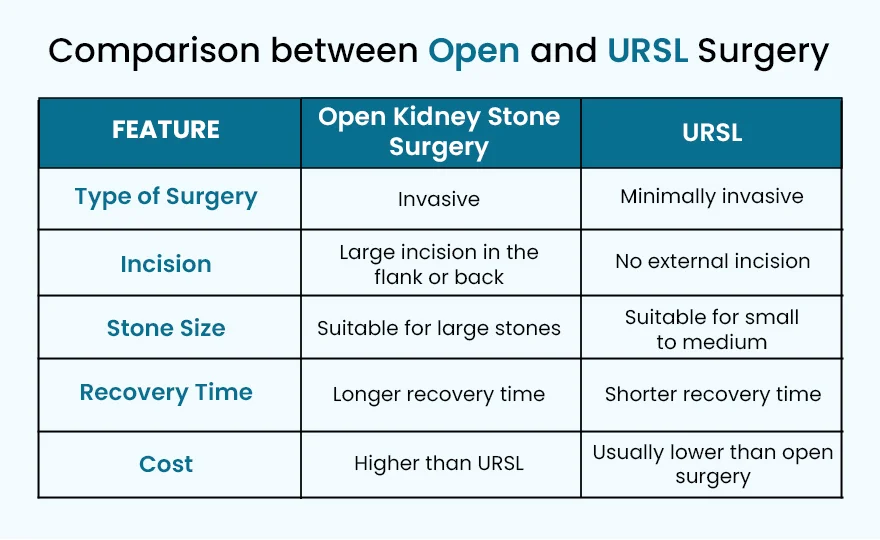
Ureteroscopy, or Ureterorenoscopy, is a procedure in which a small, flexible scope (ureteroscope) is inserted through the urethra into the bladder and ureter to diagnose and treat urinary tract problems, including stones. The stone may be removed without making an incision.


Frequently Asked Questions
How long is the recovery period after URSL surgery?
The recovery period typically ranges from a few days to a week, depending on the size of the stone and the extent of the surgery. Patients may experience some discomfort and urinary symptoms during this time.
 Chat with Kidney Expert
How long does the URSL Surgery take?
The procedure usually takes about 30 to 60 minutes, depending on the size and location of the kidney stone.
Is the USL procedure painful?
Generally, general or spinal anaesthesia is used for the procedure, but local anaesthesia or conscious sedation may also be used. Usually, patients do not experience significant pain during the URSL (Ureteroscopic Surgery) procedure itself because they are given anaesthesia to numb the area and put to sleep with general anaesthesia. However, after the procedure, some patients may experience mild to moderate discomfort, such as pain or soreness in the lower back or abdomen and burning during urination. As your urologist recommends, these symptoms usually improve within a few days and can be managed with over-the-counter pain relievers.
Does insurance cover the surgery?
Yes, all Insurances are covered with no hidden charges. Our team facilitates paperwork on your behalf, ensuring smooth approvals. Contact HexaHealth for an easy, cashless & hassle-free experience.
What is the cost of Surgery for Kidney Stones?
The exact cost is dependent upon the following factors:
- Doctor’s consultation charge
- Type of hospital
- Size and shape of the stone
- Unilateral or bilateral treatment
- Location of the kidney stones
- Admission charge
- Type of the surgery planned to be performed, whether conventional or Laser
- The health condition of the patient
- Post-surgical complications that are involved
- The admission room that you opted for.
Contact HexaHealth for price transparency.