Chat with Kidney Expert
Cost of Treatment for KIDNEY STONES in Bengaluru - RIRS

Cost of Treatment for KIDNEY STONES in Bengaluru - RIRS
 Painless Laser Procedure
100% Insurance Coverage
Get Surgery Today & Pay Later
Free Pick Up & Drop
No Doctor Consultation Charges
100+
JCI & NABH Hospitals
1,500+
Expert Doctors
8,000+
Happy Patients


Risks of Delayed RIRS Treatment
- Increased pain and discomfort
- Progression of the condition
- Recurrent Urinary Tract Infections
- Blockage in Urinary Bladder
- Permanent Damage to Kidneys
Treatment Cost Depends On

Type of
Procedure

Severity of
the Disease

Past Medical
Condition

Contact
for exact cost
Frequently Asked Questions
What happens during the RIRS procedure?
During the RIRS (Retrograde Intrarenal Surgery) procedure, the patient is usually given general anaesthesia, although in some cases, local anaesthesia with sedation may be used. Here are the general steps involved in the RIRS procedure:
- A cystoscope is inserted into the bladder through the urethra, allowing the urologist to view the inside of the bladder and ureter.
- A small guide wire is inserted through the cystoscope and advanced into the kidney.
- A flexible ureteroscope, a thin and long tube with a camera and a laser or other instruments on its tip, is passed over the guide wire and into the kidney.
- The urologist will then use the instruments to locate the kidney stone or other abnormal tissue and remove it or break it into smaller pieces that can be quickly passed out of the body in urine.
- After the procedure, a stent (a small, soft tube) may be placed in the ureter to help heal and promote urine flow.
 Chat with Kidney Expert
How long does the RIRS procedure take?
The duration of the RIRS (Retrograde Intrarenal Surgery) procedure can vary depending on several factors, including the size and location of the kidney stone or other abnormal tissue being treated, the patient's anatomy, and the complexity of the procedure. In general, the RIRS procedure can take anywhere from 45 to 60 minutes.
Is the RIRS procedure painful?
Most patients do not experience significant pain during the RIRS (Retrograde Intrarenal Surgery) procedure itself because they are given anaesthesia to numb the area and put to sleep with general anaesthesia. However, after the procedure, some patients may experience mild to moderate discomfort, such as pain or soreness in the lower back or abdomen and burning during urination. These symptoms usually improve within a few days and can be managed with over-the-counter pain relievers, as your urologist recommends.
Does insurance cover the surgery?
Yes, all Insurances are covered with no hidden charges. Our team facilitates paperwork on your behalf, ensuring smooth approvals. Contact HexaHealth for an easy, cashless & hassle-free experience.
What is the cost of Surgery for Kidney Stones?
The exact cost is dependent upon the following factors:
- Doctor’s consultation charge
- Type of hospital
- Size and shape of the stone
- Unilateral or bilateral treatment
- Location of the kidney stones
- Admission charge
- Type of the surgery planned to be performed, whether conventional or Laser
- The health condition of the patient
- Post-surgical complications that are involved
- The admission room that you opted for.
Contact HexaHealth for price transparency.
How effective is RIRS at treating kidney stones?
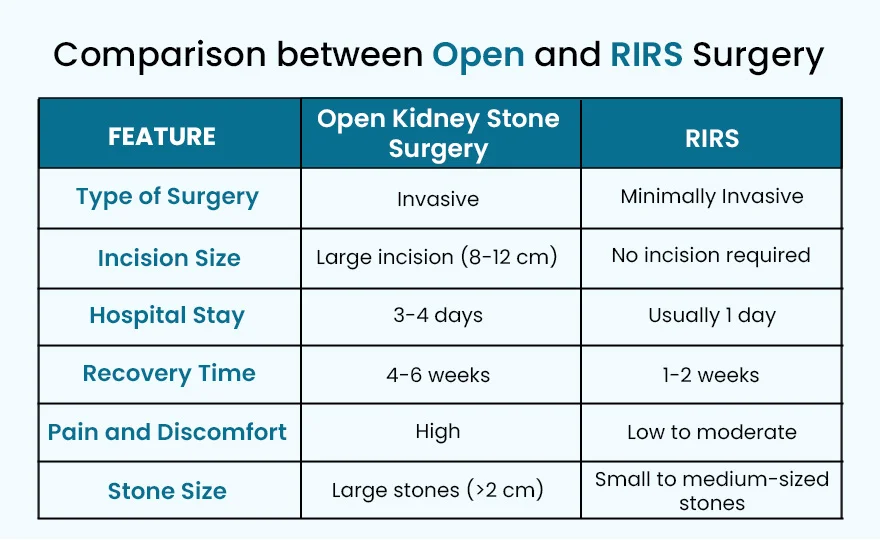
RIRS (Retrograde Intrarenal Surgery) is a highly effective treatment for kidney stones, with success rates ranging from 79% to 98% depending on the size and location of the stones and other factors, such as the experience of the urologist performing the procedure. RIRS is particularly effective for treating smaller stones (less than 2 cm in diameter) in the kidney or upper ureter.
Compared to other traditional kidney stone treatments, such as shock wave lithotripsy (SWL) and percutaneous nephrolithotomy (PCNL), RIRS has several advantages, including:
- Higher success rates for stones located in the lower pole of the kidney or the middle and upper parts of the ureter.
- Lower risk of complications, such as bleeding or damage to surrounding tissues, compared to PCNL.
- Fewer restrictions on physical activity during recovery compared to SWL.
However, RIRS may not be the best option for larger or more complex stones.
What are Kidney Stones?
Kidney Stones are also known as Nephrolithiasis or Renal Calculi. These hard deposits form inside one or both the kidneys and vary in size and number.
What is RIRS Treatment?
RIRS (Retrograde Intrarenal Surgery) is a minimally invasive surgical technique for treating kidney stones and other kidney-related disorders. It is an endoscopic procedure that allows urologists to access the inside of the kidney through the urethra, bladder, and ureter without making any incisions on the body.